

Grown Woman Reinvention: Work, Income, and What Comes Next



Your résumé may list everything you are responsible for and still fail to prove that you are an asset.
Employers want to know what becomes better because you are there.
What grows? What improves? What gets faster, safer, easier, or more profitable? What problems do you prevent?
Your first task is to show the receipts.
“Managed projects” tells a recruiter what you did.
Led a six-month implementation across four departments, corrected a three-month backlog, and established the reporting process used by senior leadership.
That statement shows the level at which you worked and the value you brought to the organization.
A duty describes your labor.
An accomplishment proves your value.
Your Job Title Does Not Tell the Whole Story
Two people can hold the same job title while carrying completely different levels of responsibility.
One may support a single department. The other may manage several locations, supervise employees, coordinate vendors, work with senior executives, and make decisions that affect thousands of customers.
The title alone does not reveal the difference.
Internal titles create another challenge. A title that makes sense inside your company may mean very little to an outside employer.
“Field Service Manager,” “Program Specialist,” or “Administrative Coordinator” could represent entry-level support, operational leadership, or something in between.
Your résumé has to translate the title into language the outside market understands.
It needs to show:
- What you handled
- The level at which you handled it
- What improved because you handled it
Most résumés capture the first one.
The second and third are where your value lives.
Gather the Receipts Before You Rewrite the Résumé
Many people ask ChatGPT to rewrite their existing résumé.
The rewritten version may sound polished while repeating the same incomplete information.
AI can only work with what you give it.
If your résumé leaves out major projects, invisible leadership, difficult problems, and measurable results, the new version will leave them out too.
Gather the evidence first.
As discussed in Black Women Are the Economic Warning Signal: What the 2026 Jobs Numbers Are Telling Us, records of your work may become inaccessible after a layoff, resignation, retirement, or system change.
Build a personal career evidence file while you still have access to the information.

Save approved, nonconfidential copies of:
- Performance evaluations
- Awards and recognition
- Promotion announcements
- Job descriptions
- Training records
- Professional licenses
- Project summaries
- Reports showing results
- Customer compliments
- Letters of recommendation
- Emails acknowledging your contribution
- Presentation titles
- Calendars showing recurring responsibilities
- Personal notes about problems you solved
Keep confidential company records, customer information, trade secrets, proprietary data, and private employee information protected.
Record the facts you are permitted to use:
- What happened
- What you were asked to do
- What action you took
- Who was affected
- What changed
- How the result was measured
- Who can verify your contribution
Memory fades. Systems change. People leave.
Write it down while you can still show the receipts.
Five Ways You Create Value
A company takes on a financial and operational risk every time it hires someone.
Your résumé needs to show that the value you create is greater than the cost and risk of employing you.
Most professional accomplishments fall into five categories.
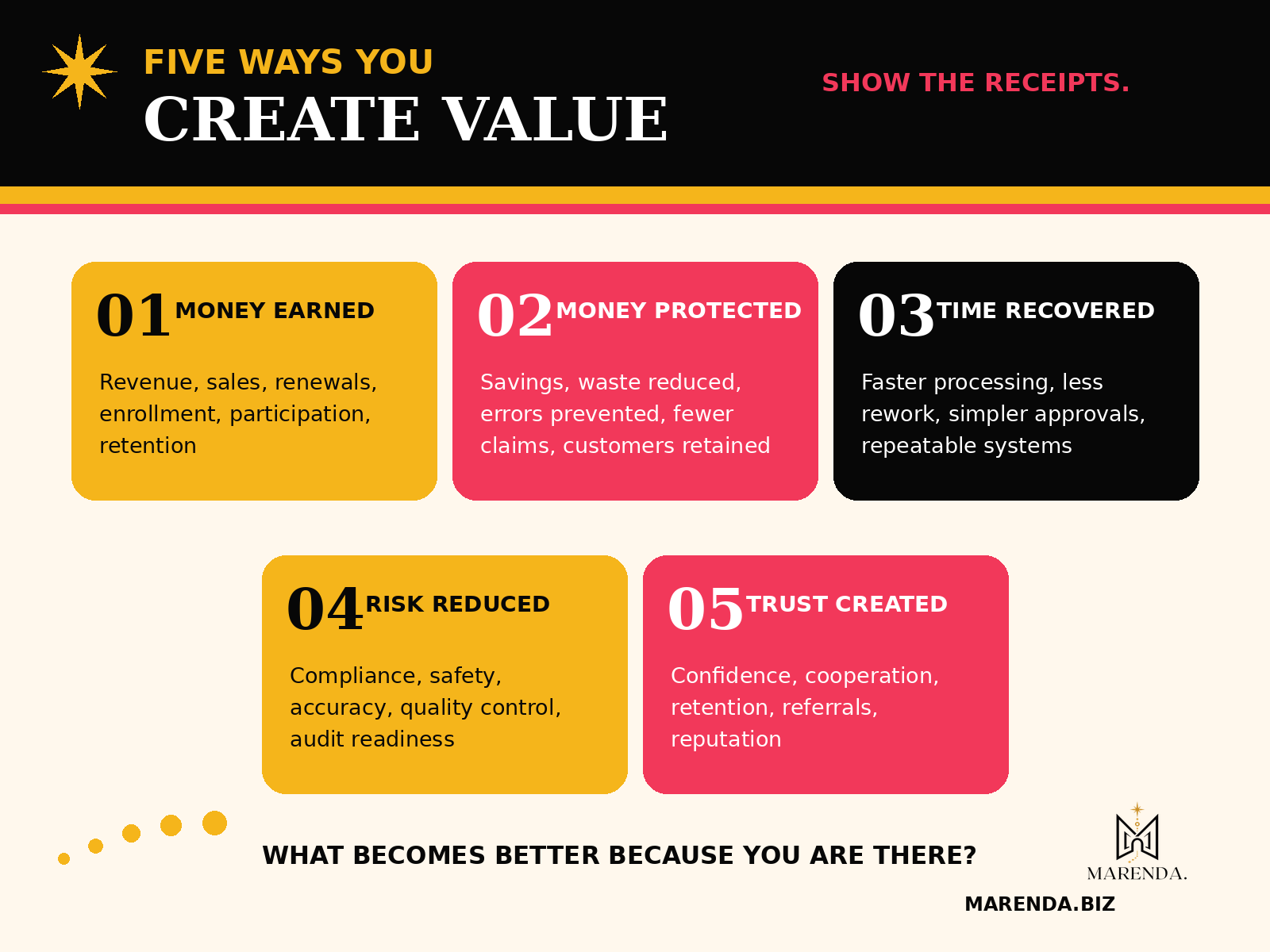
1. You Earned Money
You helped increase:
- Revenue
- Sales
- Renewals
- Donations
- Enrollment
- Participation
- Customer retention
- Contract value
- Product adoption
A direct financial result is useful, but revenue is only one form of value.
2. You Protected Money
You helped reduce:
- Waste
- Overtime
- Refunds
- Errors
- Vendor expenses
- Rework
- Penalties
- Claims
- Unnecessary purchases
- Customer loss
Preventing a costly problem can be as valuable as producing new revenue.
3. You Recovered Time
You made something:
- Faster
- Easier to process
- Easier to find
- Easier to approve
- Easier to repeat
- Less dependent on one employee
- More consistent across teams
Time has economic value.
A process that saves 20 minutes may sound small. A process that saves 20 minutes for 50 employees every week tells a different story.
4. You Reduced Risk
You improved:
- Compliance
- Safety
- Documentation
- Quality control
- Audit readiness
- Data accuracy
- Training completion
- Policy adherence
- Incident response
A company needs people who can protect operations, customers, employees, money, and reputation.
Show where you have done that work.
5. You Created Trust
You strengthened relationships with:
- Customers
- Employees
- Executives
- Vendors
- Partners
- Donors
- Patients
- Passengers
- Government agencies
- Community members
Trust can lead to stronger retention, participation, cooperation, referrals, customer satisfaction, and crisis response.
Connect the relationship to something observable.
“Built strong relationships” is vague.
“Rebuilt communication with a dissatisfied client, resolved the service issue, and retained the account” shows what the relationship produced.
Show the Level You Operated On
You may not have a perfect percentage or dollar amount for every accomplishment.
You can still prove the size and difficulty of the work.
The evidence is often hiding in the scope.
Scope signals include:
- Number of employees supported
- Number of customers served
- Number of locations covered
- Size of the territory
- Number of cases processed
- Number of projects managed at the same time
- Frequency of reports or events
- Length of the project
- Number of departments involved
- Level of executive exposure
- Regulatory requirements
- Time available to solve the problem
- Volume of communications produced
- Size of the budget
- Number of vendors coordinated
- Consequences of an error or delay
Compare these statements:
Coordinated employee training.
Coordinated monthly compliance training for 140 employees across three locations.
The second statement does not invent an outcome. It gives the employer enough context to understand the responsibility.
Compare:
Responded to customer complaints.
Managed time-sensitive customer escalations involving operations, billing, and executive-response teams.
The stronger statement reveals complexity, judgment, and exposure.
Scope signals are especially useful when financial data is confidential, unavailable, or difficult to isolate.
You can prove the level of the work without making up a result.
Pay Attention to What Everybody Trusted You to Handle
Years of experience can make valuable work feel ordinary.
You may think:
- That was part of my regular job.
- Everybody in management knows how to do that.
- I helped, but I did not lead the entire project.
- I never received an official promotion for it.
- The company did not measure the outcome.
- I handled it because somebody had to do it.
Look closer.
Who trained the new employees?
Who handled the angry customer?
Who explained the policy nobody understood?
Who organized the information before the executive meeting?
Who fixed the process that kept causing problems?
Who could be trusted with confidential, urgent, or high-stakes work?
Who did people call when something had to be handled correctly?
Patterns of trust belong in your professional record.
Your résumé should explain what you were trusted to handle and why that trust was earned.
Claim Your Contribution Accurately
A team accomplishment can still belong on your résumé.
Your wording should identify the part you played.
Use verbs such as:
- Led
- Co-led
- Coordinated
- Designed
- Implemented
- Analyzed
- Recommended
- Trained
- Facilitated
- Contributed to
- Supported
- Served as the primary contact for
Then connect your action to the larger result.
For example:
Analyzed recurring service complaints and recommended workflow changes that contributed to a 17 percent reduction in repeat cases.
This statement identifies the contribution without claiming sole ownership of the team’s result.
You should be able to explain every accomplishment during an interview.
Who was involved?
What did you personally do?
How was the result measured?
What would have happened without your contribution?
Clear answers strengthen your credibility.
You Can Prove Your Value Without a Perfect Percentage
Some organizations measure everything.
Others have weak reporting systems, restrict access to financial data, or never calculate the results of individual contributions.
A proxy measure can help demonstrate the effect or scale of your work when a direct financial result is unavailable.
Useful proxy measures include:
- Backlog reduced
- Processing time shortened
- Participation increased
- Repeat complaints declined
- Training completion improved
- Deadlines met
- Audit findings resolved
- Response time improved
- Manual steps eliminated
- Documents consolidated
- Employees trained
- Locations supported
- Events completed
- Cases handled
- Errors corrected
- Escalations resolved
Every proxy needs a factual basis.
If you do not know an exact number, use language you can defend:
- More than 100 employees
- Approximately 30 cases per week
- Multiple departments
- A regional project
- A high-volume operation
- A recurring monthly process
Honest scale is stronger than a statistic you cannot prove.
Match Your Receipts to What the Employer Needs
A strong résumé does more than list your best accomplishments.
It presents the accomplishments that matter for the position you want.
The job posting provides part of the employer’s evaluation criteria.
Read it for repeated responsibilities, business problems, required skills, level of authority, stakeholders, technology, and working conditions.
Then review the occupation through O*NET OnLine. O*NET is sponsored by the U.S. Department of Labor and provides information about occupational tasks, knowledge, skills, abilities, work activities, and technology requirements.
Build a competency-to-evidence crosswalk using four categories:
- What the employer needs
- Evidence from your history
- Scope or result
- Where the evidence belongs on your résumé
Here is an example:
What the employer needs: Cross-functional leadership
Your evidence: Led a policy implementation involving Operations, Human Resources, and Legal
Scope or result: Three departments and a six-month deadline
Résumé placement: Professional experience
Another example:
What the employer needs: Process improvement
Your evidence: Redesigned a case-intake workflow
Scope or result: Reduced the backlog from 180 cases to 45
Résumé placement: Professional experience
This exercise shows where your experience matches the position.
It also exposes missing evidence.
If the employer wants budget-management experience and you have never managed a budget, better wording will not create that qualification.
You can look for related experience, complete relevant training, develop a work sample, or pursue a position that matches the evidence you already have.
Make ChatGPT Investigate Before It Starts Writing
Most résumé prompts tell AI to rewrite the document.
This prompt gives ChatGPT a different assignment.
It must investigate your evidence, identify what is missing, separate your individual contribution from team results, and build a case for your value before writing the résumé.
Gather:
- The target job posting
- Your current résumé
- Approved performance reviews
- Awards
- Project notes
- Job descriptions
- Career memories
- Results and numbers you can verify
Remove private company information, employee identification numbers, customer data, medical information, and confidential material before uploading anything.
Copy This Career Evidence Audit Prompt
Use this prompt in ChatGPT before asking it to rewrite your résumé.
You are conducting a career-evidence audit before rewriting my résumé.

Your job is to uncover credible proof of my value, identify missing evidence, and translate my experience into language that an employer outside my current organization can understand.

I will provide:

1. A target job posting
2. My current résumé
3. Selected performance reviews, awards, project notes, job descriptions, or career memories
4. Any results and numbers I can verify

Complete the work in seven stages.

STAGE 1: DECODE THE EMPLOYER’S EVALUATION CRITERIA

Extract the job posting into a table with:

• Required function or competency
• Exact language used by the employer
• Evidence the employer would expect to see
• Likely business problem behind the requirement
• Level of responsibility implied
• Whether the requirement appears mandatory, preferred, or repeated
• Relevant nouns and phrases that should appear naturally in a qualified résumé

Look beyond keyword matching. Identify signals involving scale, complexity, decision-making, risk, speed, stakeholders, regulation, leadership, and measurable outcomes.

STAGE 2: BUILD MY EVIDENCE INVENTORY

Review every document and memory I provide.

Extract evidence into these categories:

• Money earned
• Money saved or protected
• Time recovered
• Risk reduced
• Trust, retention, participation, or reputation strengthened
• Problems solved
• Systems or processes created
• People trained, developed, or led
• High-stakes situations handled
• Work performed beyond my formal title

For every item, record:

• My action
• The situation or problem
• Who benefited
• The result
• Available metric
• Scope signal
• Source of the evidence
• Confidence level: verified, strongly supported, or needs confirmation

STAGE 3: FIND OVERLOOKED SCOPE SIGNALS

Search for details that demonstrate the level at which I operated, including:

• Team size
• Customer or case volume
• Locations or territory
• Budget
• Project length
• Number of departments or stakeholders
• Executive exposure
• Regulatory or safety responsibility
• Frequency
• Deadline pressure
• Operational consequences
• Degree of independence

Do not invent numbers. When a useful fact is missing, ask me one specific question that could recover it.

STAGE 4: CREATE DEFENSIBLE PROXY MEASURES

When revenue or savings figures are unavailable, identify honest proxy measures such as volume, time, participation, completion, error reduction, backlog reduction, response speed, geographic reach, frequency, or number of people affected.

Label every proxy clearly. Explain why it is relevant.

Do not calculate or imply a result unless my evidence supports it.

STAGE 5: RUN A CONTRIBUTION AND CREDIBILITY CHECK

Separate:

• Results I produced independently
• Results I led
• Results I co-led
• Results I contributed to
• Results achieved by the larger team

Flag vague claims, unsupported superlatives, inflated leadership language, confidential details, unexplained internal terminology, and any statement I may struggle to defend in an interview.

STAGE 6: BUILD THE COMPETENCY-TO-EVIDENCE CROSSWALK

Match each important requirement in the target job to my strongest evidence.

Rate each match:

• Strong proof
• Related proof
• Weak proof
• No proof supplied

For weak or missing areas, tell me whether I should:

• Provide additional evidence
• Reframe related experience
• Add training or a work sample
• Leave the claim out

STAGE 7: WRITE THE RÉSUMÉ MATERIAL

After completing the audit, write:

• A targeted professional summary
• A core-competencies section
• Revised experience bullets
• A LinkedIn headline
• Three interview stories using the Situation, Task, Action, and Result structure

Write each résumé bullet using the strongest available combination of:

• Action
• Operating context
• Scope
• Change produced
• Evidence
• Why the result mattered

Use clear language. Preserve my professional level and voice.

Do not invent experience, numbers, credentials, software knowledge, leadership authority, or results.

Before writing, ask me up to 10 high-value questions that would materially strengthen the evidence.

Prioritize questions about scope, measurable change, risk, decision-making, stakeholders, and work I performed beyond my title.

Here is the target job posting:

[PASTE JOB POSTING]

Here is my current résumé:

[PASTE RÉSUMÉ]

Here is my supporting career evidence:

[PASTE APPROVED INFORMATION]
Protect your information: Remove confidential company records, customer data, employee identification numbers, medical information, and other private material before uploading documents.
Turn the Receipts Into Résumé Bullets
Use this structure:
Action + operating context + scope + change + evidence + significance
You will not need every element in every bullet.
Before
Responsible for employee communications.
After
Developed weekly operational communications for more than 200 employees, translating policy changes into action steps for frontline teams and managers.
Before
Assisted with project management.
After
Coordinated schedules, status reporting, and issue escalation for a six-month implementation involving Operations, Technology, and Customer Care.
Before
Helped improve participation.
After
Redesigned outreach and follow-up, increasing program participation from 23 percent to 34 percent.
The stronger versions show the environment, scale, action, and result.
Watch: Highlight Your Ability, Not Your Experience
In this TED talk, Jason Shen explains why employers should evaluate demonstrated ability instead of relying too heavily on conventional credentials.
His argument supports the work you have completed here.
Show what you can do.
Bring the evidence.
These Receipts Can Take You Beyond One Job
The evidence you recover can strengthen:
- Your résumé
- LinkedIn profile
- Interviews
- Salary negotiations
- Professional biography
- Portfolio
- Consulting proposal
- Government-contracting capability statement
- Speaking introduction
- Freelance profile
- Business service description
A project that proves you can improve onboarding may support an HR role, training contract, onboarding audit, workshop, or consulting service.
A record of managing customer escalations may support work in customer experience, operations, quality assurance, account management, training, or crisis communications.
Your experience can travel beyond the company and industry where you acquired it.
The value is in the function you performed, the problem you solved, and the result you produced.
Your Next Move
Choose one position you may want next.
Then:
- Save the job posting.
- Collect five pieces of approved career evidence.
- Identify three accomplishments connected to money, time, risk, trust, or a solved problem.
- Add at least one scope signal to each accomplishment.
- Run the Career Evidence Audit prompt.
- Answer the questions it produces.
- Verify every claim before adding it to your résumé.
A job title describes where your experience was used before.
Your receipts prove that you are an asset wherever you decide to take it next.
Sources and Further Reading
U.S. Department of Labor Employment and Training Administration: O*NET
Jason Shen: Looking for a Job? Highlight Your Ability, Not Your Experience
Black Women Are the Economic Warning Signal: What the 2026 Jobs Numbers Are Telling Us


