Grown Woman Reinvention: Work, Income, and What Comes Next



The unemployment rate rarely tells the whole story.
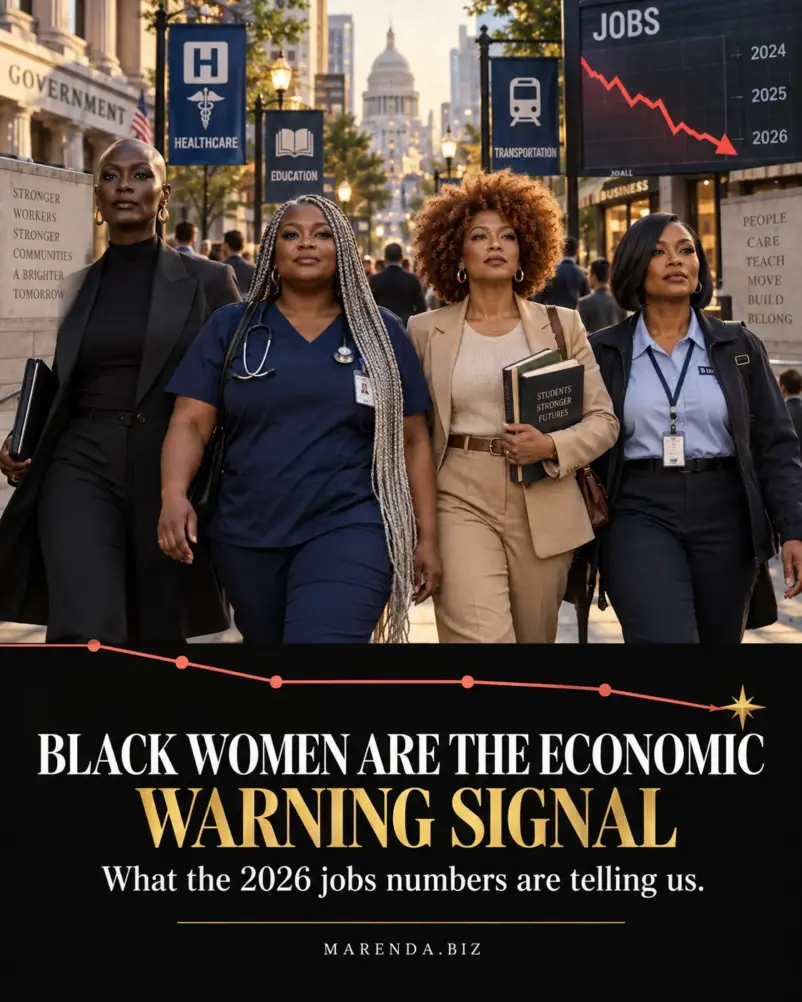
In June 2026, the unemployment rate for Black women age 20 and older was 5.7 percent. That was lower than the 7.1 percent recorded in February.
That sounds like progress.
A deeper look at the numbers tells a different story.
Between February and June 2026:
| Employment measure | February 2026 | June 2026 | Change |
|---|---|---|---|
| Unemployment rate | 7.1% | 5.7% | Down 1.4 percentage points |
| Labor-force participation rate | 63.7% | 61.3% | Down 2.4 percentage points |
| Black women in the labor force | 11.369 million | 10.982 million | Down 387,000 |
| Employed Black women | 10.565 million | 10.353 million | Down 212,000 |
A lower unemployment rate occurred alongside fewer Black women working and fewer Black women participating in the labor force.
That distinction matters.
The unemployment rate counts people who remain in the labor force and actively seek employment. The labor-force participation rate measures the share of the adult population that is either working or actively seeking work.
When people pause their job searches, begin caregiving, return to school, retire earlier than planned, become discouraged, or leave the workforce for another reason, they move outside the unemployment calculation.
The unemployment rate can fall while the number of employed people also falls.
As a Black woman from Compton, an employee, entrepreneur, caregiver, and political strategist, I read these numbers through a practical question:
What do these changes mean for our families, and what can we control during the next 30 days?
This Trend Began Before 2026
The 2026 numbers follow a difficult year for Black women in the workforce.
The Institute for Women’s Policy Research found that Black women experienced a net loss of 113,000 jobs between January and December 2025.
During the height of the summer employment decline, Black women accounted for 54.7 percent of job losses among women while representing 14.1 percent of the female workforce.
Black women also experienced an employment decline of over 30 percent within the federal government during 2025. The corresponding declines were 11.6 percent for women overall and 8.1 percent for men.
Federal workforce reductions were substantial across the government.
The U.S. Government Accountability Office reported that nearly 378,000 employees separated from 22 major federal agencies during 2025 while those agencies hired approximately 127,000 people. The combined workforce across those agencies declined by nearly 256,000 employees between December 2024 and January 2026.
Federal employment accounts for approximately 5.1 percent of employed Black women, so federal reductions explain one portion of the wider employment decline. Pressure also exists across professional and service occupations, including healthcare, education, social work, administration, and community services.
Why Black Women Serve as an Economic Warning Signal
Black women have a long history of high workforce participation.
We work. We lead households. We care for children, spouses, parents, relatives, and communities. We frequently carry professional responsibilities and family responsibilities at the same time.
Black women also hold significant roles in sectors that help the country function:
- Healthcare
- Education
- Government
- Social services
- Administration
- Transportation
- Retail
- Hospitality
- Community organizations
- Small businesses
Many of these sectors respond quickly to government reductions, institutional restructuring, funding changes, inflation, healthcare costs, automation, and weaker consumer spending.
When employment begins falling among people who have historically participated in the workforce at high rates, the change deserves serious attention.
The effects extend across entire households.
A lost job can affect:
- Household income
- Health insurance
- Life insurance
- Disability insurance
- Retirement contributions
- Paid leave
- Childcare
- Eldercare
- Transportation
- Mortgage payments
- Credit use
- College expenses
- Spending at local businesses
When one woman’s earnings support several people, one employment disruption can reach several households.
This is a structural economic issue.
Training, networking, freelancing, and entrepreneurship can create options. Fair hiring, worker protections, access to healthcare, access to capital, contracting opportunities, and responsible public policy shape those options.
Both levels require attention.
What Black Women Can Do During the Next 30 Days
We deserve an honest assessment of the economy. We also deserve a practical response.
The next 30 days can be used to protect what already exists, strengthen professional mobility, create another income source, and begin building something we own.
1. Build a Career Evidence File
Your employer may hold records of your work inside systems that become inaccessible after a separation.
Create a personal career file now.
Save approved copies of:
- Performance evaluations
- Awards and recognition
- Training certificates
- Professional licenses
- Job descriptions
- Promotion letters
- Leadership assignments
- Project results
- Presentations approved for external use
- Letters of recommendation
- Names and personal contact information for trusted colleagues
Write each major accomplishment using this formula:
I improved what, from which starting point, to which result, by taking which action.
Example:
Increased program participation from 23 percent to 34 percent by redesigning team communication, outreach, and follow-up.
A job title describes your position.
Documented results show your value.
2. Review Every Workplace Benefit
Employment changes can affect several forms of protection at the same time.
Review:
- Health insurance
- Life insurance
- Short-term disability
- Long-term disability
- Critical illness coverage
- Accident insurance
- Hospital indemnity coverage
- Long-term care coverage
- Health Savings Account funds
- Flexible Spending Account funds
- Retirement accounts
- Retirement-plan loans
- Paid leave balances
- Beneficiary designations
Ask Human Resources for:
- Coverage termination dates
- Portability rules
- Conversion rights
- Election deadlines
- Post-employment premium amounts
- Treatment of benefits during leave
- Retirement loan repayment rules
Request the information in writing and save it outside your work email.
The strongest time to understand a benefit is before a deadline begins.
3. Strengthen Your Professional Visibility
Your professional identity should exist beyond your employer’s internal directory.
Update:
- Résumé
- LinkedIn headline
- LinkedIn About section
- Professional biography
- Portfolio
- Reference list
- Personal email signature
- Industry memberships
- Professional headshot
- Contact information
Your headline should communicate function and results rather than an internal title alone.
Instead of:
Program Manager
Use:
Program Manager | Workforce Operations, Employee Experience and Process Improvement
Instead of:
Administrative Professional
Use:
Administrative Operations Specialist | Scheduling, Documentation and Executive Support
Make it easy for someone outside your current organization to understand what you do.
4. Create One Portable Income Offer
A portable offer is the fastest route from an existing skill to an additional income opportunity.
It can take the form of:
- Freelancing
- Consulting
- Contract work
- A workshop
- A one-time service
- Project-based support
Choose a skill that can produce a clear result within a defined period.
Examples include:
- Résumé review
- Interview preparation
- Event coordination
- Bookkeeping
- Grant research
- Social media support
- Virtual assistance
- Insurance education
- Project management
- Research
- Writing
- Graphic design
- Caregiving organization
- Training facilitation
Package the skill around an outcome.
Instead of offering:
Social media management
Offer:
A 30-day content calendar with 20 captions, hooks, posting instructions, and reusable templates.
Instead of offering:
Caregiving consulting
Offer:
A 90-minute family caregiving organization session that produces a medical-information binder, appointment tracker, emergency contact sheet, and benefits checklist.
A strong portable offer has:
- A specific customer
- A specific problem
- A specific deliverable
- A specific completion time
- A clear price
The first goal is income and market evidence.
Which problem generates interest? Which customer responds? Which offer sells?
Those answers can become the foundation of a business.
5. Start a Business Around a Problem You Can Solve
Freelancing and starting a business are related, yet they represent different economic moves.
A portable offer creates an immediate income lane.
A business adds the operating structure required to attract customers repeatedly, manage money, document processes, build recognizable assets, pursue contracts, hire support, and create value that extends beyond one project.
Black women are among the fastest-growing groups of employer business owners in the United States.
The number of Black women-owned employer businesses grew from fewer than 45,000 in 2017 to approximately 79,000 in 2023, an increase of 78 percent.
That growth exceeded the 62 percent increase among Black-owned employer businesses overall, the 60 percent increase among Black male-owned employer businesses, and the 20 percent increase among female-owned employer businesses overall.
The Brookings analysis measures employer businesses, meaning businesses with paid employees. It therefore reflects a deeper level of business development than occasional contract work or an informal side hustle.
Los Angeles gained over 3,500 Black-owned employer businesses between 2017 and 2023, placing the region among the leading metropolitan areas for Black employer-business growth.
The opportunity is real.
The strategy is to build with structure.
Days 1–3: Choose the Customer and Problem
Identify:
- The specific customer
- The urgent problem
- The result the customer wants
- The experience or skill that qualifies you to help
- The simplest paid solution you can deliver well
Write one business statement:
I help [specific customer] achieve [specific result] through [specific service or product].
Example:
I help family caregivers organize medical information, appointments, benefits, and emergency records through a guided care-planning service.
Days 4–7: Choose the Revenue Model
Decide how the business will earn money:
- One-time service
- Monthly service
- Group program
- Workshop
- Digital product
- Physical product
- Membership
- Licensing
- Affiliate income
- Government contracts
- Corporate contracts
Choose one primary offer for the first month.
Several offers can come later. One clear offer provides stronger market evidence.
Days 8–14: Establish the Business Foundation
Complete the steps that apply to your location and business activity:
- Choose a business name
- Search state and local name records
- Select a business structure
- Register the business where required
- Apply for an Employer Identification Number when appropriate
- Open a separate business bank account
- Create a bookkeeping system
- Confirm license and permit requirements
- Review business insurance needs
- Establish an invoice and payment process
- Create folders for contracts, receipts, taxes, and customer records
The business structure affects taxes, liability, paperwork, and access to funding. Registration and licensing requirements vary by location and business activity.
The IRS issues EINs directly and free of charge.
Days 15–21: Build the Sales and Delivery System
Create:
- One offer
- One price
- One payment link
- One landing page
- One intake form
- One agreement
- One delivery checklist
- One follow-up message
- One testimonial request
- One referral request
The system should create a consistent customer experience.
Each time the service is delivered, document the steps.
Documentation turns personal effort into a repeatable process.
Days 22–30: Find the First Customers
Create a list of 30 potential:
- Customers
- Referral partners
- Community organizations
- Companies
- Government agencies
- Professional associations
- Contracting opportunities
Use a direct outreach message:
I launched [business name] to help [specific customer] achieve [specific result]. My first offer provides [deliverable] for [price]. I am opening [number] spaces this month and would appreciate a referral to someone who could benefit.
Track:
- People contacted
- Responses
- Conversations
- Proposals
- Sales
- Customer questions
- Delivery time
- Customer results
- Referral sources
The first month should produce evidence.
Use that evidence to refine the customer, offer, price, message, and process.
Build Toward an Asset
The long-term goal is a business that has value beyond the owner’s daily labor.
Build toward:
- Recurring revenue
- Documented procedures
- Customer records
- Business credit
- Contractors or employees
- Government contracts
- Corporate contracts
- Branded products
- Intellectual property
- Licensing
- A recognizable brand
- A business capable of expansion or transfer
Black women already possess expertise, relationships, creativity, and community knowledge that can become valuable enterprises.
The next stage is converting that knowledge into ownership, systems, revenue, and economic power.
6. Strengthen Your Relationship Network
Reconnect with:
- Former supervisors
- Former coworkers
- Alumni
- Professional associations
- Community organizations
- Recruiters
- Vendors
- Contractors
- Industry leaders
- People who understand the quality of your work
Send a clear message:
I am strengthening my professional network and exploring opportunities in [field]. My strongest experience is in [specific function], where I produced [specific result]. I would value staying connected and hearing about relevant roles, contracts, or partnerships.
Make the message specific enough for people to recognize an opportunity that fits you.
A vague request produces vague support.
7. Track State, Local, and Institutional Opportunities
National employment changes receive the headlines.
Many practical opportunities operate through:
- State agencies
- County departments
- City governments
- School districts
- Community colleges
- Hospitals
- Transportation agencies
- Public utilities
- Workforce development boards
- Small Business Development Centers
- Local procurement offices
- Large employers
- Community foundations
These organizations hire employees, purchase services, award contracts, and fund training.
Create a weekly opportunity review.
Track:
- Open positions
- Vendor registrations
- Requests for proposals
- Grants
- Certifications
- Training programs
- Networking events
- Industry meetings
- Contract deadlines
Follow employment opportunities and purchasing opportunities.
A job application creates one path.
A vendor registration can create another.
Personal Preparation and Institutional Accountability Belong Together
Black women deserve practical strategies, and institutions carry responsibility for the conditions reflected in the data.
Employers should examine:
- Layoff patterns by race and gender
- Promotion rates
- Pay equity
- Hiring criteria
- Leadership pipelines
- Caregiver support
- Return-to-work practices
- Contractor selection
- The effect of restructuring on frontline services
Policymakers should support:
- Timely employment data
- Strong workplace protections
- Affordable healthcare
- Childcare and family-caregiving support
- Workforce-development funding
- State and local contracting opportunities
- Responsible small-business financing
- Public-sector career pipelines
- Transparency during large workforce reductions
Individual effort has power.
Institutional decisions determine the environment in which that effort operates.
What the Numbers Are Really Saying
The 2026 employment numbers show a clear tension.
Black women’s unemployment rate fell between February and June, yet the number of employed Black women also fell. Labor-force participation declined sharply during the same period.
Reading only the unemployment rate would miss that story.
Black women are working, leading, caregiving, starting businesses, and carrying expertise across every part of the economy.
We are also navigating an employment environment shaped by workforce reductions, changing public policy, sector instability, rising household costs, and unequal access to opportunity.
The response requires several moves at once:
- Protect existing income and benefits
- Document professional value
- Strengthen career visibility
- Create a portable income offer
- Start businesses with structure
- Build strong professional relationships
- Track employment and contracting opportunities
- Demand accountability from employers and policymakers
Black women’s employment is a national economic indicator.
When our participation declines, families feel it. Communities feel it. Institutions feel it. Businesses feel it.
The warning is already visible.
The next move is preparation, ownership, strategy, and collective accountability.
Sources and Further Reading
- U.S. Bureau of Labor Statistics, Employment Status of the Civilian Population by Race, Sex, and Age, June 2026
- U.S. Government Accountability Office, Federal Agency Workforce Changes: Update for July 2025 to January 2026
- Institute for Women’s Policy Research, One Year Into Trump’s Second Term, Black Women Face Disproportionate Job Losses
- Brookings Institution, Black Employers Are Reaching New Heights
- U.S. Small Business Administration, Launch Your Business
- Internal Revenue Service, Get an Employer Identification Number
Employment estimates are seasonally adjusted and may be revised as additional data becomes available. Business, legal, licensing, insurance, and tax requirements vary by location, structure, and activity. Review current government requirements and consult qualified professionals when appropriate.