Grown Woman Reinvention: Work, Income, and What Comes Next


You can have several good ideas and still choose the wrong income strategy.
A consulting business may fit your experience. A new credential may open a better-paying field. Contract work may put money in your account faster. A full-time job may offer the health insurance and predictability your household needs.
Each path serves a different purpose.
Before you ask, “What should I do next?” ask a more useful question:
What does the money need to do?
Does it need to arrive quickly? Replace a salary? Include benefits? Create flexibility? Build an asset you can eventually own or sell?
The right answer depends on the job the income must perform in your life.
This is where many reinvention plans go sideways. People compare ideas by how exciting they sound instead of how well they solve the financial problem in front of them.
Your next move needs a job description too.
Complete your career evidence inventory first with Your Résumé Is Leaving Money on the Table. Your income options become easier to evaluate when you know what you can prove.
Start With the Financial Problem
Income decisions become clearer when you separate urgency from ambition.
You may want to build a business and still need a paycheck first. You may want a new career but need temporary contract work while you complete training. You may have enough financial runway to pursue a slower opportunity with a higher ceiling.
These are different conditions. They call for different plans.
The Federal Reserve reported that 59 percent of adults experienced at least one major unexpected expense in 2025. Only 63 percent said they could cover a hypothetical $400 expense using cash or its equivalent. Twelve percent lacked an available way to cover the expense.
That is why timing matters. A bill due this month requires an income source capable of producing money this month.
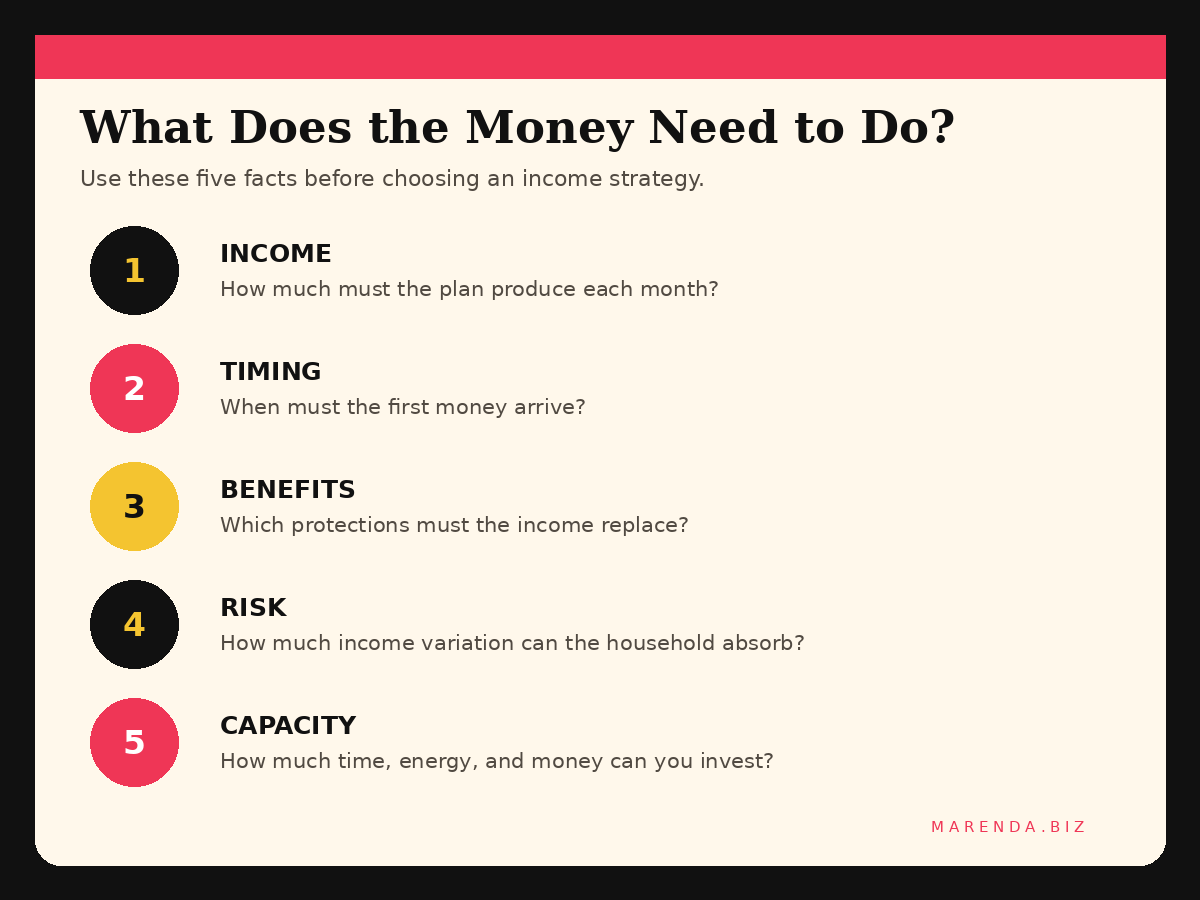
Start with five facts:
- How much income must be replaced?
- How soon must the first money arrive?
- Which benefits must be replaced?
- How much uncertainty can your household absorb?
- How much time, energy, and money can you invest before the plan produces a return?
Answer with the obligations, resources, and capacity you have today. Your plans for six months from now belong in the next stage of the decision.
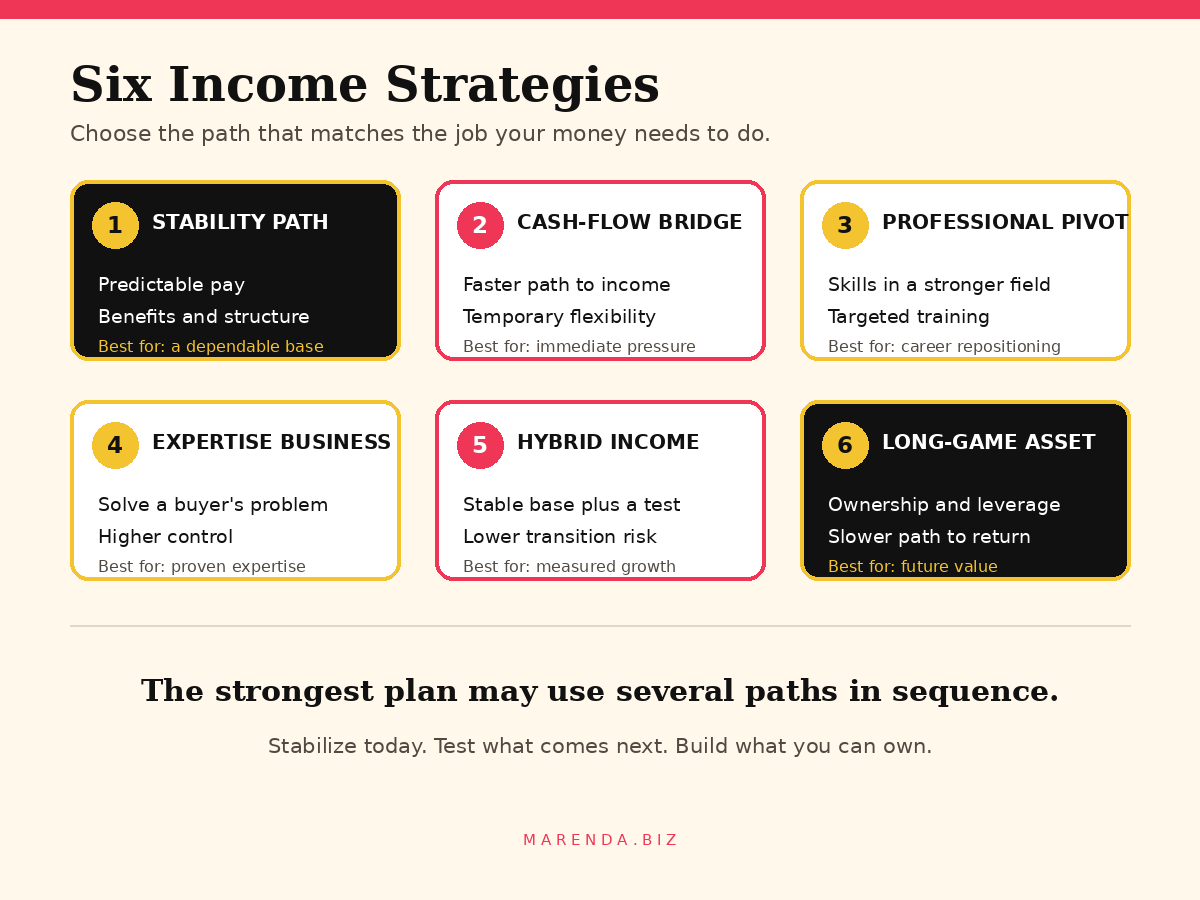
Six Income Strategies and What Each One Is Built to Do
One path can handle today while another path builds your future.
You can use one strategy to stabilize your present and another to build your next chapter. The important thing is to know which job each strategy is doing.
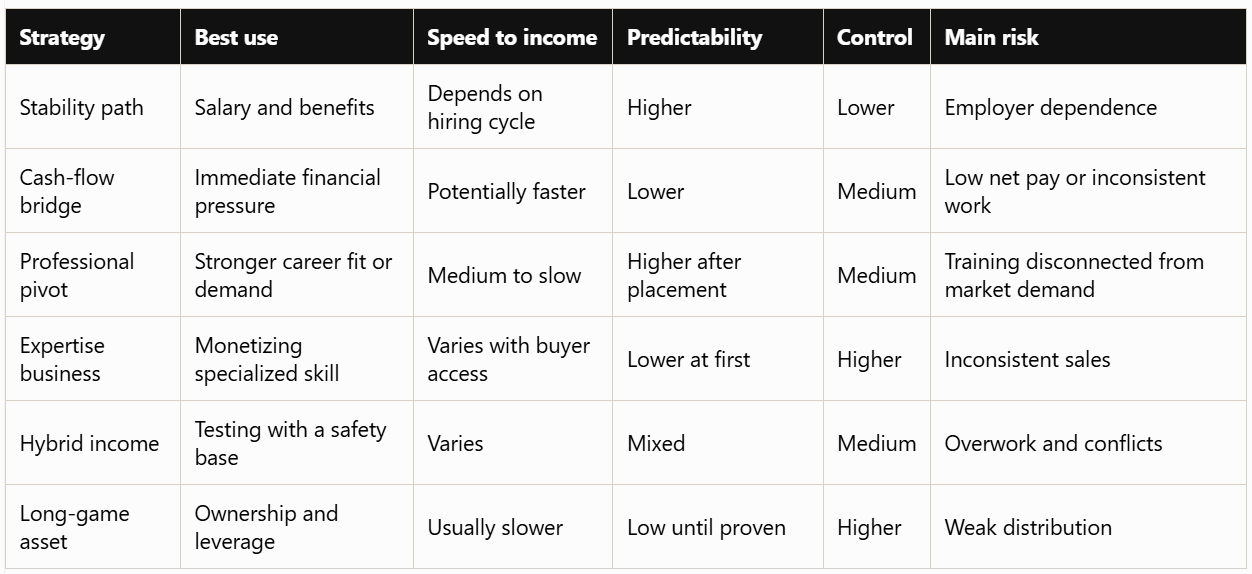
1. The Stability Path
Primary job: Produce predictable income and access to employer-sponsored benefits.
This path usually means a full-time or substantial part-time employee position. It may be the right choice when your household needs a reliable pay schedule, health coverage, paid leave, retirement contributions, or easier income verification for housing and credit.
The stability path can take your existing function into a different industry. It may involve a lower-stress role, a government position, or an employer with better benefits and boundaries.
Its main tradeoff is control. Your income depends on an employer’s hiring decision, compensation structure, policies, and continued need for the role.
Use this path when:
- Your essential expenses require dependable monthly income.
- Health insurance or other benefits are a priority.
- You want to reduce financial volatility.
- You need a stable base before building something else.
2. The Cash-Flow Bridge
Primary job: Put money in motion while a longer plan develops.
A cash-flow bridge may include contract assignments, temporary work, project-based services, seasonal work, tutoring, event support, delivery work, pet care, administrative support, or selling unused items.
The best bridge uses resources you already have. It should require little training, limited startup spending, and a short path to a paying customer or employer.
A bridge serves a temporary assignment: reduce the pressure on your savings and buy time for a stronger decision.
Watch the math. Take-home pay equals gross revenue minus transportation, platform fees, supplies, insurance, unpaid time, and taxes.
Use this path when:
- You need income before a traditional hiring process is likely to finish.
- You have a skill or resource you can use immediately.
- You need temporary flexibility.
- You can state what the bridge must earn and when it should end.
3. The Professional Pivot
Primary job: Move your existing value into a field with better demand, pay, conditions, or longevity.
A pivot often begins with functional translation instead of a complete restart.
Operations experience can travel into health care, logistics, education, government, or technology. Customer escalation work can support roles in client success, quality assurance, compliance, training, or account management. Program coordination can transfer into project management, implementation, grants, or community engagement.
The pivot may require a credential, portfolio, software skill, or new vocabulary. Your twenty years of judgment still carry value, even when part of the work feels new.
Ask, “Where else does the market pay for the functions I already know how to perform?”
Use this path when:
- Your skills remain useful but your industry or role has weakened.
- You can invest time in targeted training or proof.
- You want a new professional direction with employee-level stability.
- A nearby field values your experience differently.
4. The Expertise Business
Primary job: Turn a problem you know how to solve into a service someone will pay for.
This path includes consulting, coaching, training, bookkeeping, writing, project support, compliance assistance, recruiting, facilitation, research, design, and specialized operational services.
The starting point is a buyer with an expensive, urgent, recurring, or frustrating problem. The logo, website, and business cards can follow once the offer is clear.
Your experience becomes marketable when you can explain:
- Who has the problem
- What the problem costs them
- What you do to improve it
- What evidence supports your ability
- What the buyer receives
- What you charge
Independent work also creates responsibilities your employer previously handled. The IRS states that self-employed people generally must file an annual return and pay estimated taxes quarterly. Health coverage, insurance, retirement saving, sales, contracts, recordkeeping, and unpaid administrative work now belong in your calculations.
Use this path when:
- You can name a specific buyer and business problem.
- You have credible evidence that you can produce the result.
- You are willing to sell, follow up, and manage the business side.
- You can tolerate variable revenue while building demand.
5. The Hybrid Income Strategy
Primary job: Keep a stable base while testing another source of income.
A hybrid strategy may combine a full-time job with consulting, a part-time role with freelance work, contract assignments with a product business, or employment with a small portfolio of recurring clients.
This approach can lower the financial risk of experimentation. It allows you to test whether strangers will pay, whether you enjoy the work, and whether demand repeats before depending on it.
The constraint is capacity. A plan that requires you to work every evening and weekend may produce revenue while damaging your health, relationships, or performance at your primary job.
Review your employment agreement and company policies. Avoid conflicts of interest, misuse of confidential information, competition with your employer, or work performed on company time or equipment.
Use this path when:
- You want to test demand while keeping stable income.
- You have clear boundaries around time and workload.
- Your employment terms allow the outside work.
- The second income source can grow before your household depends on it.
6. The Long-Game Asset
Primary job: Build something that can produce value beyond each hour you personally work.
Examples include intellectual property, licensing, a book, a course, a paid resource library, a membership, a content archive, a product line, a system that others can deliver, or an ownership interest in a business or property.
This is the path people often describe as passive income. Most assets require active work, money, maintenance, distribution, or management before the income becomes dependable.
The appeal is leverage. One hour of service is usually sold once. A useful asset may be sold, licensed, accessed, or monetized repeatedly.
Attention and demand measure different things. Convert followers into customers through a verified problem, a clear offer, a reachable audience, and a realistic distribution plan. Every finished product also needs a route to its buyers.
Use this path when:
- Your immediate income needs are already covered.
- You can invest before expecting a return.
- You understand how buyers will discover the asset.
- You want to build ownership and a longer-term income ceiling.
Compare the Paths by What They Can Deliver
The table below provides planning guidance. Actual timing and income depend on your market, proof, network, pricing, location, availability, and execution.
Benefits Belong in the Calculation
A salary comparison can mislead you when the options include different benefits.
Employer-sponsored health insurance, paid leave, retirement contributions, disability coverage, life insurance, and predictable payroll all have economic value.
If you leave a job or lose job-based coverage, investigate the replacement cost before setting your required business revenue or contract rate. HealthCare.gov explains that losing qualifying health coverage can create a Special Enrollment Period, generally allowing Marketplace enrollment within 60 days before or after the loss of coverage. COBRA may allow temporary continuation of an employer plan in eligible situations, but the individual may have to pay the full group premium plus an administrative charge.
A $75,000 salary and $75,000 in business revenue create different household results.
Compare net income after taxes, business expenses, insurance, retirement contributions, unpaid time, and the benefits you must replace.
Choose a Sequence for This Season
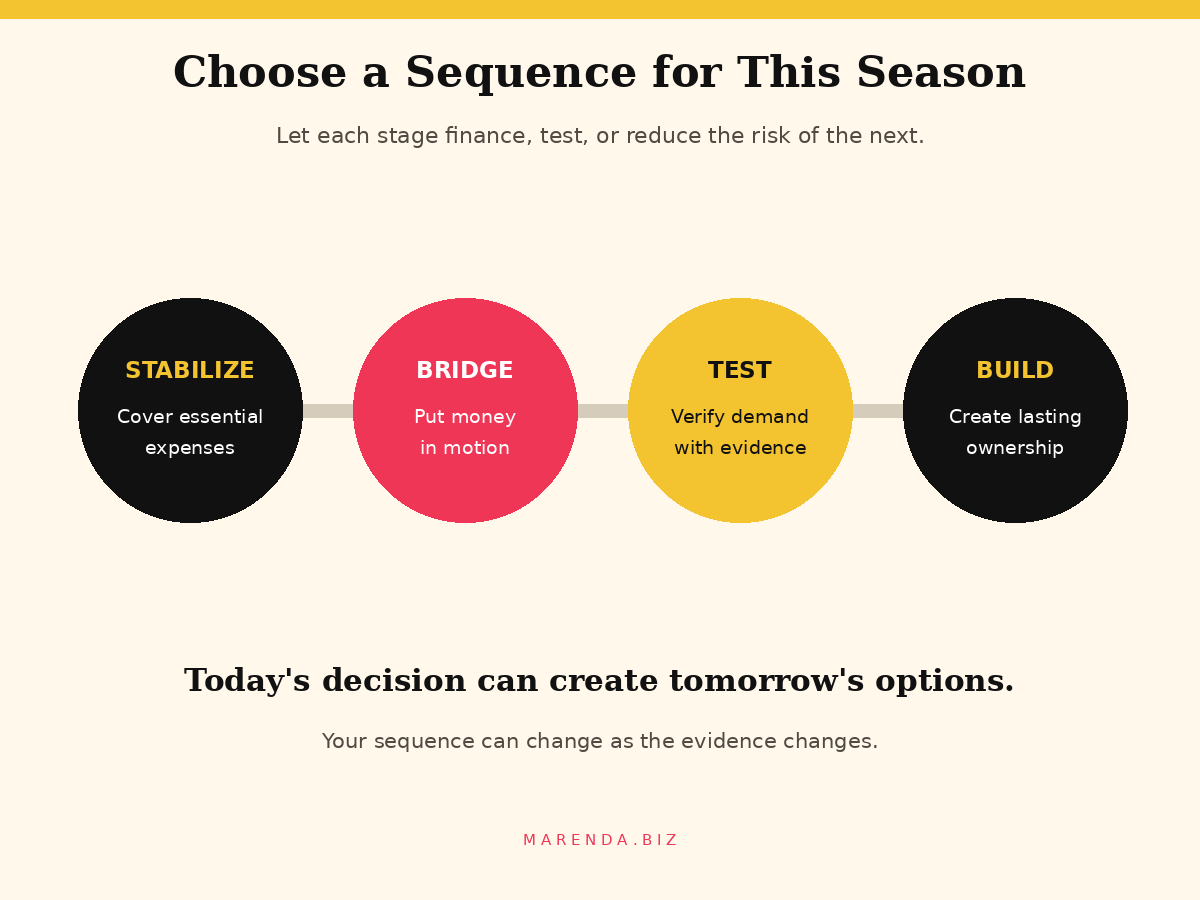
This week’s task is to choose a sequence that respects your financial reality. Future decisions can respond to the evidence each stage produces.
For example:
- First: Use contract work to slow the drain on savings.
- Next: Pursue a stable role that uses your strongest evidence.
- Then: Test one specialized service with a small number of clients.
- Later: Turn repeated client work into a resource, system, or product you own.
Another person may choose:
- Keep the current job.
- Complete a targeted credential.
- Move into a better-paying field.
- Use the higher income to fund a long-term asset.
The sequence matters because each stage can finance, test, or reduce the risk of the next one.
Make AI Evaluate the Decision First
ChatGPT can produce fifty income ideas in seconds.
The useful ideas will fit your income target, available time, benefits needs, local market, professional evidence, and tolerance for risk.
Make the tool evaluate the decision before it recommends opportunities.
Copy This Income Strategy Decision Prompt
Use this prompt before choosing a job search, pivot, business, or side-income plan.
You are helping me choose an income strategy. Begin by evaluating my financial requirements, resources, and constraints before presenting jobs, businesses, or side-income options.

Evaluate what the money needs to do, how quickly it must arrive, and how much risk my household can absorb.

I will provide information about:

1. My required monthly household income
2. My essential monthly expenses
3. My savings and financial runway
4. My health insurance and benefits needs
5. My available hours and energy
6. My current job status
7. My verified skills, experience, credentials, and career evidence
8. My location and work restrictions
9. My access to transportation, equipment, technology, and professional networks
10. My comfort with selling, uncertainty, training, and startup costs

Complete the work in five stages.

STAGE 1: DEFINE THE FINANCIAL ASSIGNMENT

Identify:

• The minimum income I need
• The target income I want
• When the first income must arrive
• Which benefits must be replaced
• My financial runway
• My maximum acceptable startup cost
• My maximum acceptable income volatility

Flag any missing number that prevents a responsible recommendation. Ask one specific question for each missing fact.

STAGE 2: ASSESS MY AVAILABLE ASSETS

Inventory:

• Transferable functions
• Specialized knowledge
• Evidence of results
• Credentials and licenses
• Professional relationships
• Tools, equipment, transportation, or space
• Available time
• Geographic or remote-work advantages

Use only the skills, demand, experience, and resources supported by the information I provide.

STAGE 3: COMPARE SIX STRATEGIES

Evaluate:

• Full-time or substantial part-time employment
• Immediate cash-flow bridge
• Professional pivot
• Expertise-based service business
• Hybrid employment and independent income
• Long-term income-producing asset

For each strategy, rate:

• Fit with my immediate need
• Likely speed to first income
• Income predictability
• Benefits access
• Startup cost
• Time and energy demand
• Required selling
• Downside risk
• Long-term income ceiling
• Strength of evidence that I can execute it

Use high, medium, or low ratings and explain each rating. Label all timing projections as planning estimates.

STAGE 4: BUILD A SEQUENCE

Recommend:

• One primary strategy
• One backup or bridge strategy
• One longer-term strategy, if my finances and capacity support it

Explain what each strategy is responsible for and why the sequence fits my situation.

Limit the plan to one primary strategy, one bridge when needed, and one longer-term strategy.

STAGE 5: CREATE A 30-DAY TEST

Give me a 30-day plan that tests the strongest assumptions before I spend heavily or make an irreversible decision.

Include:

• Five concrete actions
• Evidence I need to collect
• People or buyers I need to speak with
• Costs I should verify
• A stop, continue, or adjust decision at the end of the test

Show all unsupported assumptions. Present income as a planning range tied to evidence, and calculate take-home pay after relevant expenses and taxes.

Here is my information:

[PASTE YOUR FINANCIAL REQUIREMENTS, BENEFITS NEEDS, AVAILABLE TIME, EXPERIENCE, RESOURCES, AND CONSTRAINTS]
The first useful response should identify missing facts and compare the six strategies.
If ChatGPT jumps directly to recommendations, enter:
Stop. Define the financial assignment and assess my available assets before recommending an income path.
Watch: How to Make Hard Choices
In this TED talk, philosopher Ruth Chang explains that difficult choices can involve options with different kinds of value. The decision asks you to determine which value deserves priority.
That is useful here.
A stable job, flexible contract work, a business, and a long-term asset create different forms of value. The decision becomes stronger when you know which value your life requires now.
Your Next Move
Write down these four numbers:
- Your minimum monthly income
- Your target monthly income
- The date the first income must arrive
- The amount you can invest before the plan must pay you back
Then list the benefits you must protect and the number of hours you can realistically give the plan each week.
Run the Income Strategy Decision prompt.
Choose one primary path, one bridge if needed, and one future option worth testing later.
The goal is the right money doing the right job at the right time.
Sources and Further Reading
Federal Reserve: Economic Well-Being of U.S. Households in 2025
U.S. Bureau of Labor Statistics: Employee Benefits Survey
IRS: Self-Employed Individuals Tax Center
HealthCare.gov: Special Enrollment Period
U.S. Department of Labor: COBRA Continuation Coverage