
Read the Room

Interest rates went up again. Inflation is still taking a bite out of household budgets. Real wages slipped. Here is what those headlines could mean for your money.
Yesterday, the Federal Reserve raised interest rates.
Unless you spend your afternoon watching CNBC or reading economic reports for fun, that sentence may feel distant from your actual life.
It is not.
That decision can eventually reach your credit card statement. Your next car loan. A home equity line. A business loan. The house you have been thinking about buying. The return on the cash sitting in your savings account.
Then there is the larger issue.
People keep talking about the economy as though there is one American economic experience.
There is the economy in the headlines.
Then there is yours.
How much money comes into your house. How much leaves. What your groceries cost. Whether your paycheck stretches to Friday. Whether a $700 car repair is inconvenient or catastrophic. Whether your parents need help. Whether your grown children need help. Whether you have debt. Whether you have savings. Whether somebody before you left you assets or you are building from scratch.
So let us read the room.
What the Fed did yesterday
On September 16, 2026, the Federal Reserve raised its target range for the federal funds rate by one-quarter of a percentage point to 3.75% to 4.00%.
The Fed said inflation remains elevated and that the increase was intended to support a return toward its 2% inflation goal.
The federal funds rate is the interest rate banks charge one another for certain overnight loans.
You never receive a bill labeled “Federal Funds Rate.”
Its influence travels through the financial system.
Banks set many lending and savings rates with the broader interest-rate environment in mind. That means movements in the Fed’s benchmark can eventually influence the cost of borrowing money and the amount you can earn for saving it.
And right now, borrowing money is already expensive.
Meanwhile, prices are still rising
The latest inflation report gives the Fed a reason to remain concerned.
Consumer prices rose 3.4% from August 2025 to August 2026, according to the Bureau of Labor Statistics. Prices increased another 0.4% during August alone. Gasoline was responsible for more than one-third of that monthly increase.
Here is the number that deserves more attention.
After accounting for inflation, real average hourly earnings fell 0.3% from August 2025 to August 2026.
Read that again.
An employee can receive a higher dollar wage and still lose purchasing power when prices rise faster.
That helps explain a conversation happening in households all over America:
“I make decent money. Why does it feel like my money keeps disappearing?”
The answer may be sitting in the space between your paycheck and what that paycheck can buy.
That is your economy.
Your credit cards deserve your attention
America entered this rate increase carrying a sizable amount of consumer debt.
Credit-card balances reached $1.26 trillion in the second quarter of 2026, according to the Federal Reserve Bank of New York. Auto-loan balances reached $1.71 trillion.
The Federal Reserve’s latest available commercial-bank rate data show an average interest rate of 22.15% on credit-card accounts that were being charged interest.
Twenty-two percent changes the math.
A balance that rolls from month to month becomes expensive money.
That means this is a useful moment to pull up every card you carry and look at four numbers: the balance, the APR, the minimum payment and the amount you are sending above the minimum.
You are gathering intelligence.
Once you know which debt costs you the most, you can make better decisions about where additional dollars should go.
The goal is bigger than paying bills.
The goal is understanding what your money is doing.
Thinking about buying a house? Watch the mortgage market too.
Today, September 17, Freddie Mac reported that the average 30-year fixed mortgage rate reached 6.95%, up from 6.76% one week earlier.
The Federal Reserve does not set mortgage rates point-for-point. Mortgage rates are influenced heavily by longer-term bond markets, inflation expectations and broader economic conditions.
For a buyer, the practical issue is simple.
The interest rate changes how much house the same monthly payment can purchase.
That is why shopping for a home based only on the sales price can give you an incomplete picture.
The payment matters.
The rate matters.
Insurance matters.
Taxes matter.
Maintenance matters.
And the financial cushion left after closing matters.
An existing fixed-rate mortgage keeps its contractual rate. Someone carrying an adjustable-rate loan, using a home equity line of credit or preparing to borrow against a home has a different calculation.
Same economy.
Different kitchen table.
Higher rates have another side: your cash
Borrowers usually feel higher rates as a cost.
Savers may experience an opportunity.
Banks, credit unions and other financial institutions can offer higher yields on savings accounts, certificates of deposit and money-market products when market interest rates rise.
That creates a question worth asking:
What is your savings account paying you?
Look.
A large bank can hold your money in an account paying very little while another federally insured institution offers substantially more.
You do not need to become a Wall Street expert.
You need to know where your money is sitting and what it is earning.
That is part of reading the room too.
Why the same economy can feel completely different from one household to another
Economic news often gets reduced to national averages.
Average inflation.
Average wages.
Average mortgage rates.
Average consumer.
There is no average kitchen table.
One household may have six months of expenses in savings, a paid-off home and little consumer debt.
Another may be supporting children and aging parents while carrying a mortgage, car payment and revolving credit-card balance.
A third may have inherited a home.
A fourth may be trying to become the first homeowner in the family.
That difference matters.
And race remains part of the American financial story.
In the Federal Reserve’s 2022 Survey of Consumer Finances, median wealth for Black families was $44,890, compared with $285,010 for White families. The Fed found that Black family wealth grew substantially between 2019 and 2022, while a large racial wealth gap remained.
That is older data, and it should be read as structural context rather than a measurement of Black household wealth in September 2026.
More recent Federal Reserve research gives us another piece of the picture.
In its May 2026 report on household economic well-being, the Fed found that the share of Black adults who said they were doing okay financially or living comfortably fell five percentage points in 2025. Lower-income, Black and Hispanic adults were also more likely to use alternative forms of credit such as Buy Now, Pay Later and small-dollar credit products.
That matters because a change in borrowing costs lands differently depending on the financial cushion sitting underneath a household.
History matters.
Assets matter.
Debt matters.
Income matters.
Access to credit matters.
Family responsibility matters.
This is why “the economy is doing fine” can feel meaningless
A national economy can produce solid economic indicators while individual households feel squeezed.
Both experiences can exist at the same time.
The Fed described economic activity as expanding at a solid pace. It also said inflation remains elevated.
Households can experience that combination too.
You may have a job.
Your income may have increased.
Your retirement account may have grown.
And you may still look at the grocery receipt and wonder what happened.
The Federal Reserve found that 91% of adults surveyed in 2025 considered price increases either a major or minor financial concern. Only 63% said they could cover a hypothetical $400 emergency expense using cash, savings or a credit card they could pay in full at the next statement.
People are feeling something.
The data show some of it.
So what would I be doing right now?
- I would start with information.
- I would pull up every recurring monthly obligation in my household and identify which ones carry variable interest rates.
- I would look at every credit-card APR.
- I would check the interest rate on my savings.
- I would calculate how much cash I could access if something expensive happened tomorrow.
- I would look at major purchases I expect to make during the next six to twelve months and figure out how much financing could add to their real cost.
- And I would pay close attention to the difference between wanting something and wanting the payment attached to it.
- That last distinction can save a household a lot of money.
- This is also the time to understand your financial dependencies.
- Who depends on your income?
- Whose income do you depend on?
- What happens if one income disappears for 30 days?
- What happens at 60?
- What happens at 90?
- Where would the money come from?
Those questions sound far more practical to me than arguing about whether the economy is “good” or “bad.”
Your personal economy deserves its own strategy
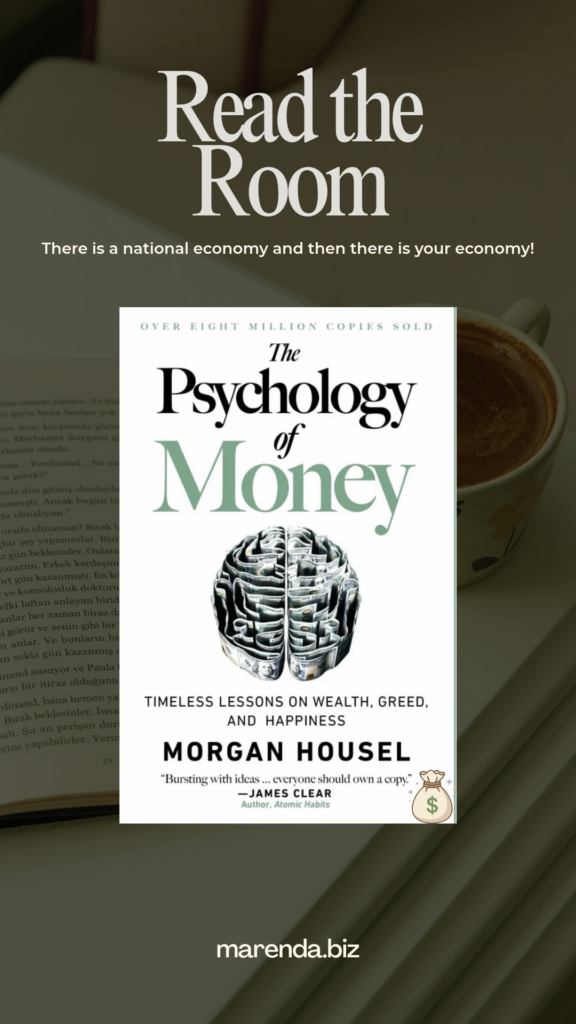 Worth Reading
The Psychology of Money by Morgan Housel
Money decisions are rarely about math alone. Housel explores how behavior, personal experience, risk and our ideas about “enough” shape what we do with money. If this article has you thinking about your own financial decisions differently, this is a useful next read.
You have limited control over interest rates.
You have limited control over inflation.
You have limited control over what gasoline costs next month.
You have considerably more influence over how informed you are about your own financial position.
That is where I want the focus.
Know what you owe.
Know what it costs.
Know what you own.
Know where your cash is.
Know what your household needs every month.
Know where you have exposure.
Know your options before you need them.
Because paying attention gives you choices.
And choices give you agency.
The Fed made its move yesterday.
Now read your own room.
READ THE ROOM
READ THE ROOM is a Marenda.biz series about paying attention to what is happening around us, understanding what it could mean in real life and making informed decisions with what we learn.
Information in this article is for educational purposes and should not be treated as individualized financial advice.


