I LOOKED INTO IT


I LOOKED INTO IT
Most private-sector workers rarely encounter pensions anymore. I looked into where they came from, why they faded, who benefited from the shift, who carries the risk now, and which companies still have them.
Did you know some companies still offer pensions?
I mean actual employer-funded pension benefits that can still be part of the compensation package for someone accepting a job now.
That surprised me, because pensions have become one of those things many of us associate with somebody else’s generation. Your mother had one. Your grandfather retired from the plant with one. Somebody you know worked for the county, the school district, the phone company, or a major corporation for thirty years and now receives a check every month.
Meanwhile, a lot of us have spent our working lives hearing a very different retirement message: contribute to your 401(k), get the company match, open an IRA, invest consistently, wait for Social Security, and hope all of those numbers eventually add up to a life you can afford after the paychecks stop.
That last part gets louder as you get older.
Will the money actually be enough?
Enough for housing. Enough for healthcare. Enough to help family when necessary. Enough to travel sometimes. Enough to absorb an emergency. Enough to live instead of spending retirement afraid to spend.
And perhaps most importantly, enough to stop working because you are ready.
That is what made the pension question interesting to me.
I started working when I was 16 years old. I am 51 now, and in thirty-five years of working I have never had an employer offer me a pension. What surprised me even more was realizing that I had never thought to seek out an employer that did.
By the time I entered the workforce, the 401(k) was already becoming the language of private-sector retirement. Pensions sounded like something people used to get.
Apparently, some people still do.
Once I discovered that, I wanted to know who.
Then I wanted to know why pensions had become so rare in the first place.
That question sent me almost 150 years backward and into a much bigger story about work, corporate America, organized labor, retirement, financial risk and what employees receive in exchange for the years they give an employer.
So I looked into it.
Pensions started because somebody had to answer what happened after the work ended
The first private pension plan in American industry is generally traced to American Express in 1875. The Pension Benefit Guaranty Corporation says many early private pensions were defined-benefit plans financed by employers.
The earliest pensions were trying to solve a very human problem and a very practical business problem at the same time.
People age.
Bodies change.
Eventually a worker who has spent decades doing a job may reach a point where continuing to do that work becomes difficult or impossible. Employers also need experienced workers to stay long enough to transfer knowledge, and eventually they need room for younger employees to advance.
A pension helped make that transition possible.
Over time, a basic bargain began to take shape: the employee would provide years of labor, knowledge, productivity and loyalty, while the employer would provide compensation during those years and some measure of financial security after the working relationship ended.
Federal policy encouraged that arrangement. The Revenue Acts of 1921 and 1926 gave employers tax advantages for pension contributions, helping employer-sponsored retirement plans expand.
World War II accelerated the growth of employee benefits. Wage controls limited how aggressively employers could compete through pay, so pensions, health benefits and other forms of compensation became increasingly important tools for attracting and retaining workers.
Labor pushed too.
Organized workers understood that Social Security was one piece of retirement rather than the entire answer. Pensions increasingly became part of collective bargaining and part of a broader argument about what workers should receive in exchange for their labor.
By 1950, private pensions covered about 10.3 million people. By 1960, approximately 23 million people, roughly half of private-sector workers at the time, had pension coverage.
Half.
Compare that with today.
In March 2025, only 14% of private-industry workers had access to a defined-benefit retirement plan, according to the Bureau of Labor Statistics.
That one number explains a lot.
It explains how someone can spend decades working in private industry and never see a pension on an employee benefits sheet.
It also raises the obvious question.
What happened?
Before pensions declined, workers had to fight to protect them
Having a pension and actually receiving the pension were once two very different things.
Studebaker became one of the most important examples.
When the automaker closed its South Bend, Indiana operation in 1963, thousands of workers discovered that the pension benefits they expected could disappear when the company and pension plan failed.
Imagine planning your retirement around income you believed you had earned, only to learn that the promise would never fully arrive.
The Studebaker collapse helped fuel the movement that eventually produced the Employee Retirement Income Security Act of 1974, better known as ERISA.
ERISA created federal standards involving pension funding, participation, vesting, disclosure and fiduciary responsibility. It also created the Pension Benefit Guaranty Corporation, which insures many private defined-benefit plans within federal limits.
One part of ERISA is especially important to this story: the law regulates plans that employers establish, but federal law generally leaves the decision to offer a pension to the employer.
That means retirement benefits are part of compensation strategy.
Some companies choose to invest heavily there.
Others choose different structures.
And beginning in the late 1970s and early 1980s, employers gained another option that would eventually transform American retirement.
The 401(k).
We changed more than the retirement account. We changed who carried the risk.
Section 401(k) entered the tax code through the Revenue Act of 1978. Federal guidance in the early 1980s helped employers begin using the provision for employee salary deferrals, and the plans grew rapidly from there.
The 401(k) offered real advantages.
Traditional pensions often rewarded long service with the same employer. The American workforce was becoming increasingly mobile. A worker might have several employers over the course of a career. A portable retirement account fit that world better because vested savings could travel with the worker.
But the pension and the 401(k) operate on fundamentally different promises.
A traditional pension is a defined-benefit plan. The plan promises a benefit according to a formula that may include compensation, age and years of service. The employer sponsoring the plan carries responsibility for funding the promised benefit.
A 401(k) is a defined-contribution plan. The worker contributes money into an individual account. The employer may contribute or match. The worker chooses among the investments offered by the plan, and the eventual account balance reflects contributions, investment performance, fees, withdrawals and time.
A pension asks the employer to deliver a benefit.
A 401(k) asks the employee to build an account.
That difference changes the retirement equation considerably.
With a 401(k), you have to determine how much you can afford to save while also paying for the life you are living today. You have to select investments. You have to remain invested through market downturns. You have to resist taking the money when an emergency arrives. Eventually you have to figure out how much you can withdraw without exhausting the account.
And none of us knows exactly how long we are going to live.
The Government Accountability Office has described the movement from traditional pensions toward defined-contribution plans as a shift of retirement responsibility and financial risk toward individual workers.
That is the part of this history I find most important.
The retirement account changed, but so did the person responsible for making retirement work.
“How 401(k) Plans Work And Why They Killed Pensions”
Employers had reasons to embrace that change. A traditional pension can create financial obligations stretching decades into the future. Companies have to manage funding requirements, investment performance, interest rates, regulatory requirements and the possibility that retirees will live longer than expected.
A defined-contribution plan makes the employer’s expense easier to predict. If the company promises a certain contribution or match, the employer can calculate that cost with considerably greater certainty.
Workers gained portability and control. Employers gained greater predictability.
Workers also inherited much more responsibility.
That distinction matters because the American retirement system increasingly assumes that workers will successfully convert decades of earnings into enough investment assets to support themselves after employment ends.
For some workers, that system can work extraordinarily well.
For others, life keeps getting between the paycheck and the retirement account.
The 401(k) works best when there is money left to put into it
Retirement advice often sounds beautifully simple.
Save consistently. Capture the company match. Invest for decades. Leave the money alone. Let compounding do its job.
Then real life shows up:
- Housing.
- Children.
- Parents.
- Healthcare.
- Debt.
- Transportation.
- Divorce.
- Caregiving.
- Job loss.
- Emergencies.
A paycheck can have twelve places to go before retirement savings ever enter the conversation.
You can tell someone to contribute 15% of her income. That advice cannot create the 15%.
That matters because a retirement system built increasingly around individual saving will inevitably reflect the economic circumstances of the individual doing the saving.
Federal Reserve data for 2025 show that among non-retirees, 69% of White adults had a tax-preferred retirement account, compared with 49% of Black adults and 46% of Hispanic adults. Only 23% of Black non-retirees said their retirement savings were on track, compared with 43% of White non-retirees.
Women also reported lower levels of retirement preparedness than men.
Those differences have roots far deeper than retirement-plan design. Income, occupational access, family responsibilities, caregiving, housing, debt and generations of economic inequality all affect how much money people have available to invest.
The shift toward individual retirement accounts did something important, though.
It made those differences matter even more.
When the system increasingly says, you save it, you invest it, you protect it and you make it last, whatever financial reality you bring into that system becomes part of your retirement outcome.
That is also why labor remains part of the story.
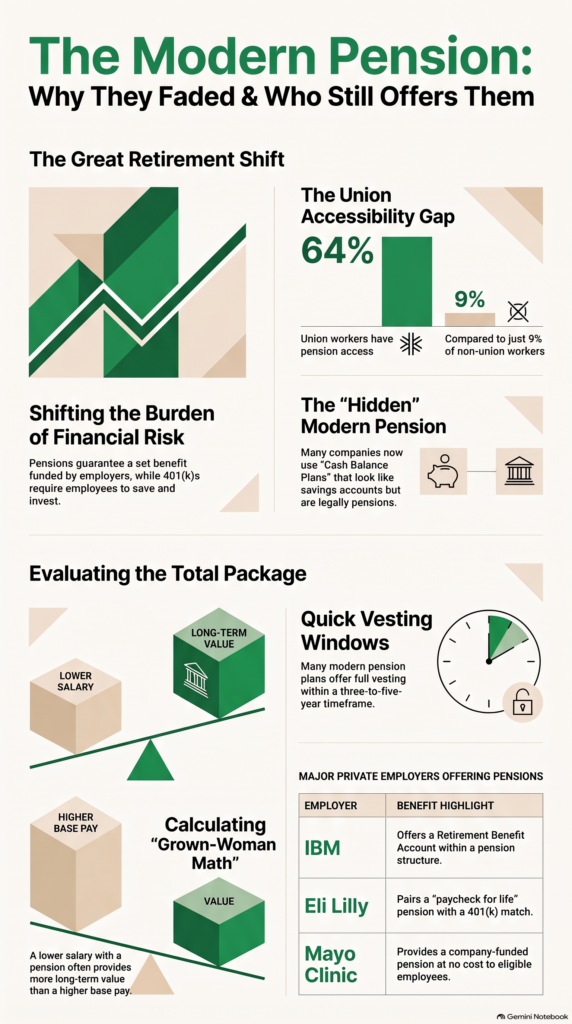
In March 2025, 64% of union workers in private industry had access to a defined-benefit pension, compared with 9% of nonunion workers.
That gap is enormous.
It is also a reminder that benefits are compensation, and compensation has always been shaped by employer decisions, labor markets and bargaining power.
Then I discovered pensions are sometimes hiding behind different names
One reason many of us assume pensions disappeared is that a modern pension does not always look like the pension somebody’s grandfather talked about.
Some companies offer cash-balance plans.
A benefits package might call it a Cash Balance Account, Personal Retirement Account or Retirement Benefit Account. Those names can sound like another savings account, but a cash-balance plan is legally a defined-benefit pension.
The employer credits the benefit according to a formula, often using pay credits and interest credits.
That was new information for me.
I could easily have read one of those terms years ago without realizing I was looking at a pension.
Once I understood that, my original question became much easier to investigate.
Who still offers these benefits?
I reviewed current employer career pages, benefits information, retirement materials and job postings, focusing on private employers whose current information indicates pension benefits remain available to eligible employees.
I found 25.
Twenty-five private employers that still offer pension benefits
This is the one section where I want the information to be easy to scan. Benefits change, eligibility varies and the details matter, so treat this as a starting point for your own research rather than the final word on any employer.
| Employer | What caught my attention |
|---|---|
| ExxonMobil | Pension benefits remain part of the U.S. retirement package for eligible employees. |
| Chevron | Eligible employees can receive a company-funded defined-benefit pension alongside the company’s employee savings plan. |
| Marathon Petroleum | A company-funded pension sits beside a substantial 401(k) company match. |
| PG&E | Current materials advertise a cash-balance pension at no employee cost alongside 401(k) matching for eligible positions. |
| Johnson & Johnson | Current job materials reference both pension and 401(k) participation for eligible employees. |
| IBM | Eligible employees may participate in its Retirement Benefit Account, which operates within its defined-benefit pension structure. |
| Phillips 66 | The company’s retirement package includes a Cash Balance Account pension and a separate savings plan. |
| Valero | Eligible employees receive a company-paid pension plus a 401(k) matching benefit. |
| Southern Company | Pension and 401(k) benefits remain part of the company’s retirement package for eligible employees. |
| NextEra Energy | Current benefits materials include both pension and defined-contribution retirement benefits. |
| Xcel Energy | Current job postings continue to reference both pension and 401(k) benefits. |
| FirstEnergy | A company-funded pension and 401(k) matching are part of the retirement package for eligible employees. |
| Ameren | Current recruiting materials include cash-balance pension and 401(k) benefits. |
| Sempra | A defined-benefit cash-balance plan sits alongside a 401(k) and other retirement benefits. |
| Merck | U.S. retirement benefits include a defined-benefit pension and 401(k) with employer contributions. |
| Eli Lilly | Lilly describes its pension as a “paycheck for life” after qualifying service and also offers a 401(k) match. |
| Williams Companies | Eligible employees can participate in the Williams Pension Plan alongside the company’s 401(k). |
| Kinder Morgan | Its retirement package includes a company-funded Personal Retirement Account structured as a cash-balance pension. |
| Travelers | Pension and 401(k) benefits remain part of its retirement package for eligible employees. |
| Nationwide | The company offers a company-paid pension alongside its 401(k) retirement program. |
| Northwestern Mutual | Current benefits include both a cash-balance pension and a 401(k). |
| Mayo Clinic | Mayo offers eligible employees a pension at no employee cost alongside an employer-supported retirement savings plan. |
| New York Life | Current employment materials continue to reference pension and retirement-savings benefits. |
| Erie Insurance | A company-funded pension remains part of its retirement package alongside the 401(k). |
| Auto-Owners Insurance | Current employee benefits include both pension and 401(k) retirement plans. |
Read the names again.
These are major employers operating now.
That is where this stopped being interesting trivia and became useful information.
Because several of these companies provide a pension and a defined-contribution retirement account.
Which means some workers are building retirement from both directions.
We may be comparing job offers using the wrong number
Most people start with salary.
That makes sense. Salary pays today’s bills.
But salary tells only part of the compensation story.
Imagine two jobs.
One pays $105,000.
Another pays $100,000.
The higher salary immediately looks stronger.
Then suppose the $100,000 job includes a substantial employer 401(k) contribution and a pension.
Now I need a calculator.
Marathon Petroleum is a good example. Its current retirement package includes a pension and a 401(k) company match. Nationwide describes a company-paid pension alongside its 401(k). Mayo Clinic offers a pension and an employer-supported retirement savings plan. Chevron combines a company-funded pension with an employee savings plan. Eli Lilly pairs its pension with a 401(k) match.
Those benefits have economic value.
At 25, I probably would have looked first at the paycheck.
At 51, I want to know what the employer is putting toward the woman I will be at 61, 66 and 71.
That is grown-woman math.
What are you paying me now?
What are you contributing toward later?
How long before that benefit becomes mine?
What could five years here produce?
What could ten?
Those questions can completely change how two job offers look.
Which raises the question a lot of people in midlife are probably thinking
Is there still time?
That question became personal for me because I am already 51 and already established with an employer.
I have years invested where I work. I have seniority. I understand my job. I have benefits. My life has been built around the work I currently do.
Walking away from that has value attached to it.
So does staying.
That is why finding an employer with a pension does not automatically make changing jobs a smart decision.
The useful question is whether the whole compensation package changes the long-term math enough to justify the move.
Several employers I researched describe pension vesting periods in the three-to-five-year range.
Three years from 51 is 54.
Five years is 56.
Ten years is 61.
Those are real years to me now.
They are close enough to calculate.
So if I were seriously evaluating one of these jobs, I would want to know what the pension could be worth after five years and after ten. I would compare salary, 401(k) contributions, healthcare, paid time off, relocation expenses, flexibility, seniority and every benefit I would surrender by leaving my current employer.
I would also want the Summary Plan Description.
That document tells you what the headline cannot: eligibility, vesting, benefit formulas, payment options, survivor rules and the details that determine what the pension is actually worth to you.
The word pension gets my attention.
The formula makes the decision.
This eventually became a bigger question about what work should give us back
Companies talk constantly about their people.
People are our greatest asset.
People drive the business.
People create the customer experience.
I believe them.
People answer the phones. People build products. People sell them. People fly airplanes. People care for patients. People operate factories. People drive trucks. People write software. People train employees. People solve problems. People carry relationships and institutional knowledge that may take years to build.
People keep companies operating.
Many large corporations produce billions of dollars in annual revenue, and human labor is part of how that value gets created.
I believe investing in the long-term security of employees is a sound way to compensate the people creating that value.
A pension is one method.
A substantial employer retirement contribution is another.
Profit sharing is another.
Employee ownership can be another.
Strong healthcare matters. Paid leave matters. Flexibility matters. Compensation can take many forms.
The principle underneath it is what matters to me:
If people spend years helping build a company, the company should help those people build a life beyond the company too.
That is why this investigation ended up being about something larger than whether I could personally get a pension.
It made me think differently about what a job is worth.
I cannot go back to 25. I can make different decisions at 51.
Learning something later in life can tempt you into rewriting your past.
If I had understood pensions at 25, maybe I would have made different career decisions.
Maybe I would have compared employers differently.
Maybe I would have asked about total compensation instead of focusing so heavily on salary.
Maybe I would have understood that a pension and a 401(k) could exist together.
Maybe.
But I cannot go back and hand my younger self information she did not have.
I have 51.
And 51 still has choices.
That is the part of this story I want other people to hear too.
You may be 42.
You may be 53.
You may be 59.
You may already feel behind.
You may have spent years taking care of everybody else.
You may have changed careers.
You may have a 401(k) that makes you nervous when you look at the balance.
You may be wondering how many more years you will have to work.
Knowing that pensions still exist does not answer those questions.
It gives you another option to investigate.
And knowing your options changes the decisions you can make.
I began this whole thing with one question:
Did you know some companies still offer pensions?
Now I have another one.
What else have we assumed disappeared, became impossible or belonged to somebody else’s generation simply because nobody told us to look?
That is exactly the kind of question I want to keep asking.
Because from now on, when I look at a job opportunity, I am looking past the salary.
Show me the healthcare. Show me the paid time off. Show me the 401(k). Show me what the company contributes. Show me when it vests. Show me the pension. Show me what five years could produce. Show me what ten could produce.
Show me the whole damn package.
The paycheck tells me what the job pays today.
I also want to know what working there could still be doing for me years after I walk out the door for the last time.