FOLLOW THE BLACK DOLLAR

Black Americans Have $2.1 Trillion in Buying Power. I Wanted to Know Who Is Getting the Money.
I have heard some version of this statistic for years: Black people have enormous buying power.
It usually appears in a presentation, a marketing report or a conversation about why companies should pay attention to Black consumers. The number changes depending on the year, but the message stays the same.
Black people spend a lot of money.
So when I saw Nielsen reporting that Black American buying power is projected to reach $2.1 trillion in 2026, I had a different question.
Who is getting the money? (Nielsen)
That question sent me down a rabbit hole.
Because $2.1 trillion sounds powerful. It is powerful. But the number by itself tells us very little about what happens after that economic power enters the marketplace. It does not tell us what Black households are buying, which industries collect the largest share, how much reaches Black-owned businesses, where consumers remain underserved, or where opportunities are sitting in plain sight.
So I started following the Black dollar.
And what I found is a much bigger story.
First, We Need to Understand What $2.1 Trillion Actually Means
Buying power and spending are related, but they are different measurements.
Nielsen cites Selig Center for Economic Growth projections putting Black American buying power at $2.1 trillion in 2026. Buying power is an estimate of the income available for spending after taxes. It is useful for understanding the economic scale of a consumer population. It should not be confused with household wealth, cash sitting in bank accounts, annual retail purchases or revenue flowing into Black-owned businesses. (Nielsen)
That distinction matters.
There is another perspective worth considering before we follow the money.
Dr. Jared Ball, a professor of Communication Studies at Morgan State University and author of The Myth and Propaganda of Black Buying Power, challenges the way buying-power statistics are commonly interpreted. His argument is especially relevant here: the ability to spend money in the marketplace is different from owning assets, accumulating household wealth or controlling the businesses receiving those dollars.
That distinction is central to this investigation.
The question is not whether Black consumers participate in a massive consumer economy. The data clearly show that they do. The deeper question is what happens to the money after it is spent, who owns the assets and enterprises collecting it, and how consumer spending translates, or fails to translate, into lasting economic ownership.
Numerator provides another window into the market. Its 2026 Black Consumer Spending Outlook estimates that Black consumers represent over $370 billion in spending across consumer packaged goods, general merchandise and quick-service restaurants, accounting for nearly 12 percent of spending in the sectors it measures. (Numerator)
The $370 billion figure does not contradict the $2.1 trillion buying-power estimate. The measurements cover different things.
One estimates economic capacity. The other tracks spending within specific consumer categories.
And then there is the household budget.
The Bureau of Labor Statistics gives us one of the clearest pictures of where money is actually going.
Follow the Money Into the Household
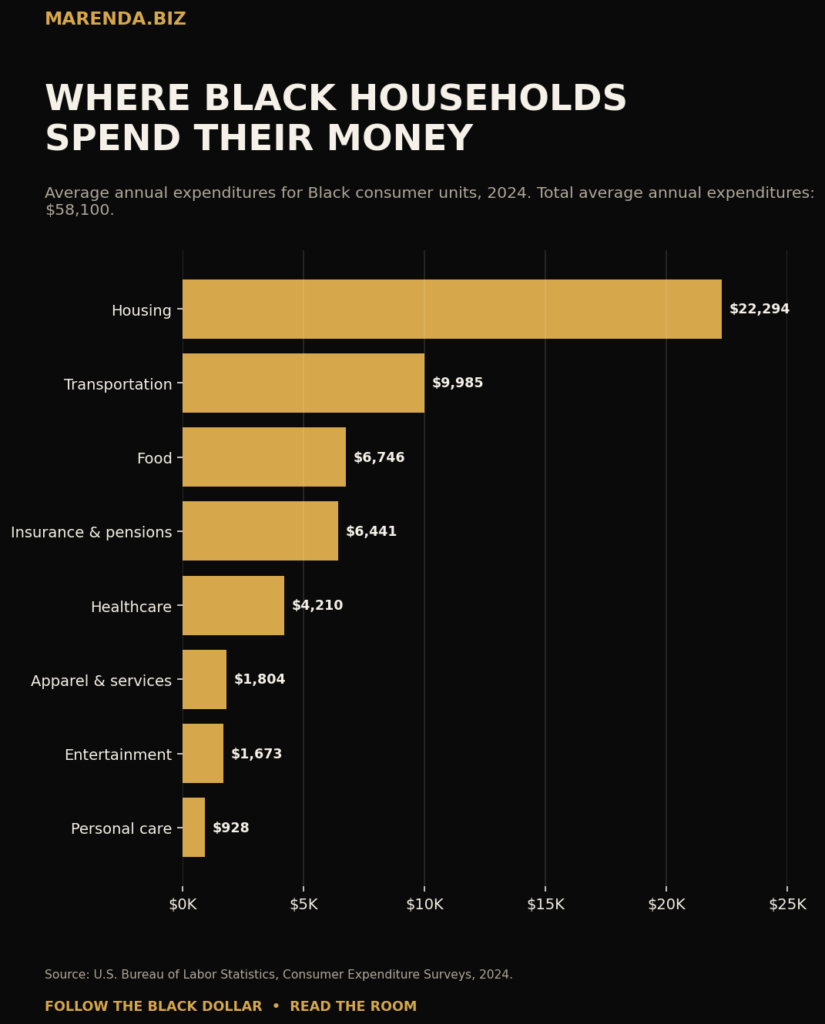
In 2024, a Black consumer unit spent an average of $58,100 annually.
Housing accounted for $22,294.
Transportation accounted for $9,985.
Food accounted for $6,746.
Personal insurance and pensions accounted for $6,441.
Healthcare accounted for $4,210.
Apparel and services accounted for $1,804.
Entertainment accounted for $1,673.
Personal care products and services accounted for $928. (FRED)
That picture immediately changes the conversation.
When we talk about the Black dollar culturally, we tend to hear about sneakers, hair, beauty, entertainment, fashion and luxury purchases.
The household data tell a different story.
The largest expense is housing.
By a lot.
Black consumer units spent an average $22,294 on housing in 2024, which works out to roughly 38 percent of average annual expenditures. Inside that number were $14,235 for shelter, $7,648 for rented dwellings, $6,142 for owned dwellings and $4,387 for utilities, fuels and public services. (FRED)
That means following the Black dollar cannot begin and end at the mall.
It leads to landlords.
Mortgage companies.
Banks.
Property insurers.
Utility companies.
Telecommunications companies.
Home-improvement businesses.
Property-management companies.
Real estate.
And local governments collecting property taxes.
The Black consumer economy is deeply connected to the infrastructure required to live.
Then There Is Transportation
Transportation was the second-largest major expenditure in the 2024 data at $9,985 per Black consumer unit.
Vehicle purchases accounted for $3,079. Other vehicle expenses accounted for $3,700. Vehicle insurance alone averaged $1,942, while maintenance and repairs accounted for $769. Public and other transportation added another $1,063. (FRED)
Again, follow the money.
Automakers get some of it.
Dealerships get some.
Banks and auto lenders get some.
Insurance companies get some.
Repair shops, tire companies, parts manufacturers, rental companies, public transit systems and fuel providers participate in the economic chain.
A dollar rarely reaches one company and stops.
It travels.
That may be the most interesting part of this entire investigation.
Food Tells Another Story
Black consumer units spent an average $6,746 on food in 2024, including $4,299 on food at home and $2,448 eating away from home. (FRED)
Those dollars move through supermarkets, restaurants, food manufacturers, distributors, delivery platforms, farmers, franchise systems and commercial real estate.
But access complicates the picture.
McKinsey has identified food as one of several areas where Black consumers have historically been underserved, alongside housing, healthcare, broadband and banking. Its research argues that unmet needs are partly the result of access and partly the result of products and services failing to meet consumer preferences. (McKinsey & Company)
That brings us to one of the biggest numbers I found.
And it may be even more interesting than $2.1 trillion.
There May Be a $300 Billion Opportunity Hiding Inside the Black Consumer Market
McKinsey surveyed consumers and analyzed unmet Black consumer demand.
Its conclusion was extraordinary.
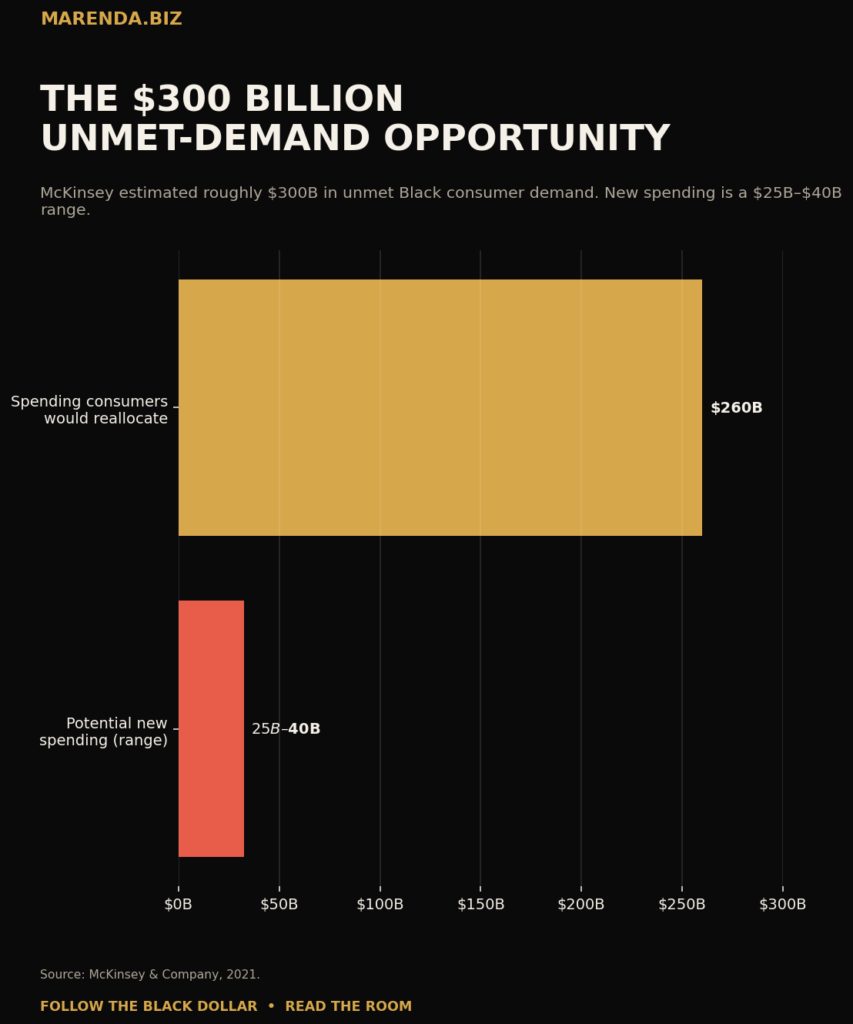
Black consumers could be willing to redirect approximately $260 billion of existing spending toward companies that serve their needs better.
McKinsey estimated another $25 billion to $40 billion in potential new spending if better products and services were available.
Together, the firm characterized the opportunity at approximately $300 billion annually. (McKinsey & Company)
Think about what that means.
The opportunity is not simply convincing Black people to spend.
The spending already exists.
A large portion of the opportunity is redirectable money.
That means the real competition is over where the dollar goes.
And Black consumers appear willing to move it.
McKinsey found that 81 percent of Black survey respondents were willing to switch brands. (McKinsey & Company)
That is a very different business story from the tired assumption that companies need to manufacture demand.
Demand exists.
The question is who will earn it.
Beauty Makes the Opportunity Easy to See
Beauty is one of the clearest examples.
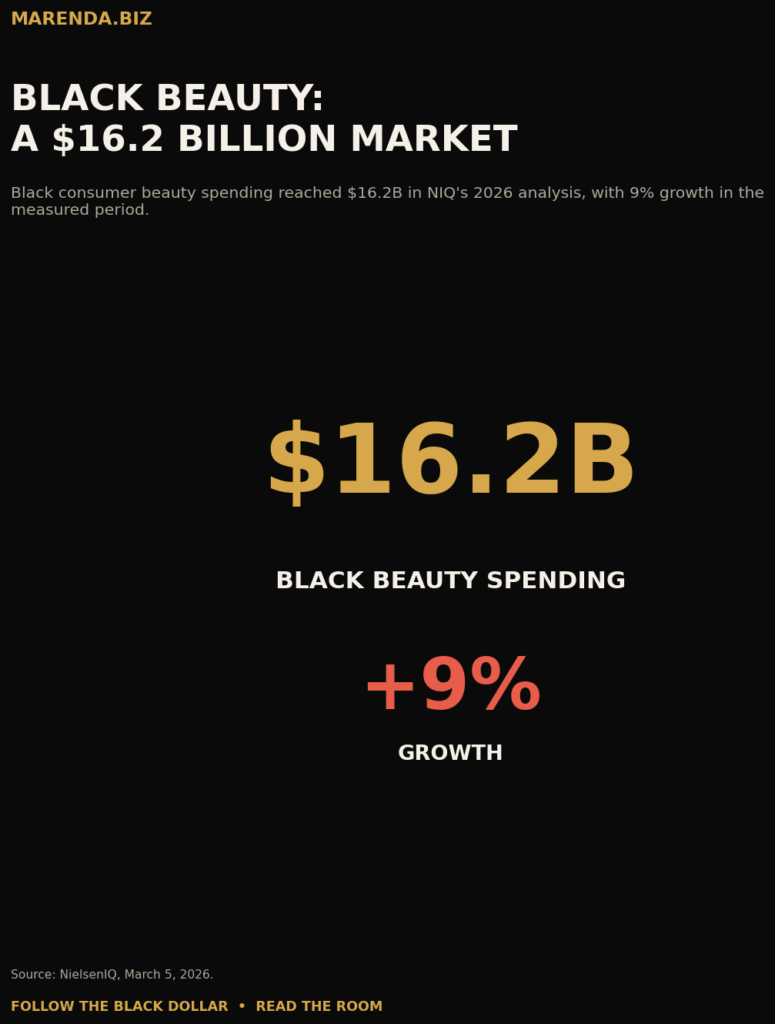
NIQ reported in March 2026 that Black consumer beauty spending had reached $16.2 billion, growing 9 percent in the measured period. (NIQ)
And this is where following the dollar becomes fascinating.
When a Black woman buys a $30 beauty product, who ultimately gets that $30?
The retailer receives revenue.
The brand receives its portion.
The manufacturer may be another company entirely.
A distributor may sit between them.
A payment processor earns a fee.
The advertising platform may have been paid to acquire the customer.
A creator may have earned a commission.
A logistics company may have moved the product.
A commercial landlord may collect rent from the store selling it.
Investors or a parent corporation may ultimately own the brand.
So asking whether Black consumers buy Black-owned products is only one part of the economic question.
We also need to ask:
Who owns the brand?
Who manufactures the product?
Who distributes it?
Who owns the shelf space?
Who owns the building?
Who financed the company?
Who earns from the transaction?
Who owns the intellectual property?
Who gets paid again when the company grows?
That is how we begin following the Black dollar instead of simply counting it.
Black-Owned Businesses Are Growing, but Look at the Structure
The Census Bureau gives us another important piece of the picture.
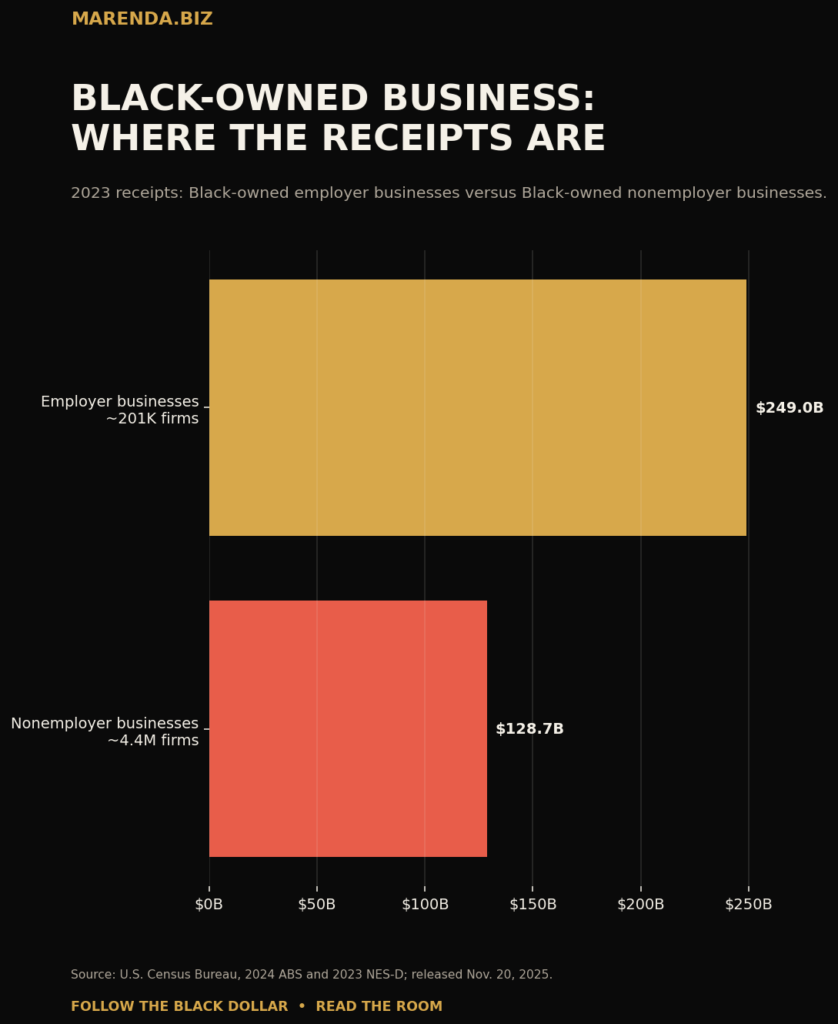
In 2023, approximately 201,000 Black-owned employer businesses generated $249 billion in receipts.
Those businesses represented about 3.4 percent of U.S. employer firms.
At the same time, approximately 4.4 million Black-owned nonemployer businesses generated $128.7 billion in receipts. (Census.gov)
That contrast stopped me.
There are millions of Black-owned businesses without paid employees and a much smaller number of Black-owned employer businesses.
Yet the smaller employer group generates substantially greater aggregate receipts.
That opens another line of questions.
What helps a Black-owned business move from self-employment into an employer business?
What happens when it hires?
What happens when it gains distribution?
What happens when it receives capital?
What happens when it becomes a supplier?
What happens when it owns manufacturing, real estate, technology or infrastructure instead of operating only at the consumer-facing end of the transaction?
Following the Black dollar eventually forces us to examine ownership and scale.
Culture Has Economic Value Too
There is another part of this story that cannot be captured entirely through household expenditures.
Black consumers influence what other people buy.
Nielsen’s 2026 research found that 67 percent of Black consumers surveyed pay greater attention to brands that reflect their culture, compared with 46 percent overall.
It also found that 52 percent of Black audiences are more likely to purchase from established brands when those brands partner with creators, personalities or organizations connected to their interests, compared with 45 percent overall.
And 70 percent said they would stop buying from brands perceived as devaluing their community. (Nielsen)
That matters because Black economic influence is operating in two directions.
There is the money Black consumers spend.
Then there is the cultural influence that can affect what the broader marketplace notices, adopts, watches, wears, listens to and eventually buys.
Black consumers are also highly reachable through digital media. Nielsen reported that Black audiences spent 32 hours per week on apps and websites across smartphones and tablets, approximately two hours above the total U.S. population in its 2025 analysis. (Nielsen)
For companies, creators and entrepreneurs, that combination of purchasing power, cultural influence and digital engagement creates a market worth studying carefully.
But Buying Power Is Still Different From Household Wealth
This is where I want to be very clear.
Celebrating $2.1 trillion in buying power without examining the economic conditions surrounding that money can create a distorted picture.
The average Black consumer unit in the 2024 BLS data spent $58,100 during the year. Of that, $22,294 went to housing, $9,985 to transportation, $6,746 to food, $6,441 to personal insurance and pensions and $4,210 to healthcare. (FRED)
Those are largely the costs of maintaining a life.
Buying power tells us that Black America represents a substantial consumer market.
It does not tell us how much of that money becomes assets.
It does not tell us how much ownership is created.
It does not tell us how much capital remains in Black households.
And it certainly does not tell us who ultimately owns the companies collecting those dollars.
That is why I am less interested in repeating the $2.1 trillion number and far more interested in following it.
So Who Is Getting the Black Dollar?
At this point, the answer is already much larger than I expected.
Housing providers are getting it.
Banks and mortgage companies are getting it.
Automakers, dealerships, lenders and insurance companies are getting it.
Grocery stores, food companies and restaurants are getting it.
Healthcare companies are getting it.
Beauty companies are getting it.
Retailers are getting it.
Technology companies are getting it.
Entertainment companies are getting it.
Travel companies are getting it.
And Black-owned businesses are getting a portion of it.
But I still want to know how much.
I want to know which companies dominate the categories where Black consumers spend heavily.
I want to know where Black-owned businesses are capturing meaningful market share.
I want to know where Black consumers are paying for products and services that still fail to meet their needs.
I want to know where a founder could build something better.
I want to know where creators have influence but little ownership.
I want to know where Black women are driving markets.
And I especially want to understand what this looks like for Black Gen X women, a group whose spending, careers, caregiving responsibilities, travel, beauty needs, housing decisions and purchasing habits deserve their own investigation.
So this article is the beginning of something.
Follow the Black Dollar
I am calling this series FOLLOW THE BLACK DOLLAR.
We are going into beauty.
Travel.
Cars.
Housing.
Food.
Banking.
Insurance.
Technology.
Entertainment.
Black-owned businesses.
And anywhere else the numbers take us.
The goal is bigger than documenting what Black consumers buy.
I want to understand who earns the money, who owns the businesses, where consumers remain underserved, where opportunities exist and where the Black dollar has the power to move markets.
Because the headline already tells us the money exists.
The household data show us where much of it goes.
The market research shows us consumers are willing to move some of it.
And the business data raise a much bigger question about who participates on the ownership side of the transaction.
We know the Black dollar is moving.
Now I want to know where it goes.