Nolan Wells was 18 years old. His cause and manner of death remain undetermined. An independent forensic pathologist documented recent unexplained blunt-force injuries to the back of his head and his back. A Mississippi grand jury declined to indict anyone. I understand what that grand jury decided. I do not accept that decision as closure.
In the words of Kendrick Lamar:
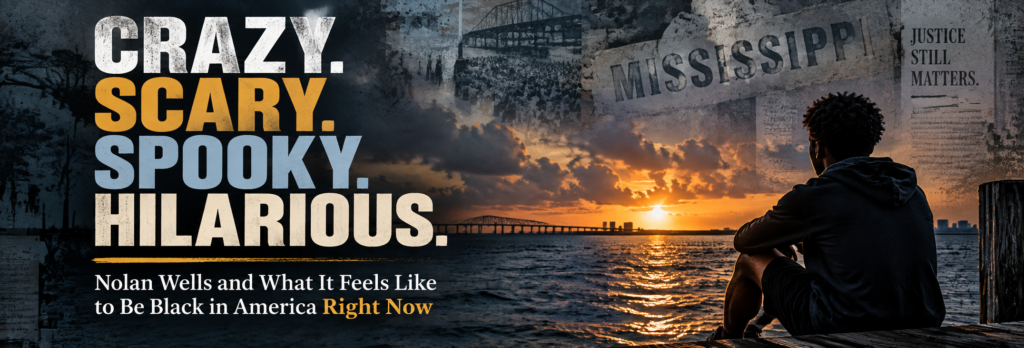
“Crazy. Scary. Spooky. Hilarious.” Kendrick Lamar, TV Off
That is about as close as I can get to describing what it feels like to be Black in America right now.
Except I am not laughing.
I am angry.
Angry beyond disappointed.
Because some of what I am watching feels less like progress and more like history.
Black people found hanging from trees. Families questioning suicide determinations. A Black woman found hanging whose death is now being prosecuted as a homicide. An 18-year-old Black man with unexplained blunt-force trauma whose cause and manner of death remain undetermined, while a Mississippi grand jury decides nobody should be indicted. Recent Associated Press reporting examined about a half-dozen cases of Black people found hanging across the South over roughly two years and the historically grounded skepticism those deaths have produced.
Meanwhile, institutions across this country are backing away from DEI, racial-equity programs and some of the mechanisms created because America has repeatedly demonstrated that declaring everyone equal does not guarantee equal treatment. The Trump administration ordered federal agencies to end federal DEI programs and directed agencies to combat what it describes as unlawful private-sector DEI preferences.
Crazy. Scary. Spooky. Hilarious.
Nolan Wells Did Not Receive a Medical Finding of “Drowning”
Let us begin there because words matter.
Nolan Xavier Wells went to Horn Island off the Mississippi Gulf Coast on July 4 with a group of friends. Everyone else in that group was white. Nolan remained on the island after several friends left. His cellphone went back toward the mainland without him. Two days later, Nolan’s body was recovered from the water.
A Jackson County grand jury spent days reviewing the case. It issued 132 subpoenas, heard from 43 witnesses through testimony, statements and recorded interviews, and reviewed cellphone information, GPS data, videos, photographs, forensic evidence, police reports and medical findings. The 23-member panel unanimously returned a no true bill, finding insufficient evidence to criminally charge anyone. It also said it found no credible evidence that Nolan’s companions engaged in criminal conduct related to his death and no evidence establishing a racial motive.
Those are facts.
This is another fact:
Both the Mississippi state medical examiner and the independent forensic pathologist hired by Nolan’s family left his cause and manner of death undetermined.
The grand jury said the location, condition, position and timing of the discovery of Nolan’s body were consistent with drowning.
That is different from a medical examiner determining that drowning was his cause of death.
That distinction matters.
Especially when another fact sits beside it.
Nolan had injuries.
Blunt-Force Trauma Is Part of This Story
The independent forensic examination conducted by Dr. Roger A. Mitchell Jr. found that Nolan sustained recent unexplained blunt-force injuries to the back of his head and additional areas of his back. Mitchell reported that red discoloration observed in the tissue at the back of Nolan’s head was confirmed as blood, while Mississippi’s original pathologist had reported two contusions in that area.
The available record also failed to establish whether Nolan entered the water voluntarily or was forced into it, or whether he was conscious when he entered the water, according to the family’s independent forensic findings.
The grand jury heard testimony from a witness who said Nolan had slipped awkwardly while getting off the side of a boat around 3:30 that afternoon. According to the report, Nolan continued socializing afterward and did not appear injured. The grand jury could not determine whether that fall caused the bruising later found on his body.
That possible explanation belongs in the record.
So does the fact that it remains a possible explanation.
It is not an established explanation for all of Nolan’s injuries.
And this is where I begin having a serious problem with the language of closure.
We have an 18-year-old with recent trauma to his head and back.
We do not have a definitive medical cause of death.
We do not know precisely how he entered the water.
We do not know whether he was conscious when he entered it.
We have a witness describing a fall, while the grand jury itself could not determine whether that fall caused the bruising.
Yet the legal process has reached a point where no criminal charge will be filed based on the evidence presented.
I understand what the grand jury concluded.
I do not agree that the publicly known evidence should leave us satisfied that there is nothing left to investigate.
And based on what has been made public, I am not persuaded by the idea that the absence of probable cause should be treated as obvious or beyond challenge.
I also recognize an important limitation: the grand jury had access to evidence I have not seen.
I am not pretending otherwise.
My point is precisely that the public record still contains unresolved facts serious enough that I reject the idea that “no indictment” should mean “nothing left to question.”
Those statements are not the same.
Today, Nolan’s Mother Asked the Question I Keep Coming Back To
On September 22, Nolan’s parents stood at New Birth Missionary Baptist Church outside Atlanta with attorneys Ben Crump and members of their legal team.
His mother, Christine Wonsley, asked how a jury could reach a conclusion consistent with accidental drowning when both medical examinations left the cause and manner of her son’s death undetermined and there was trauma to his body.
She reminded everyone of something that can get lost when a young Black person becomes a case file, a hashtag, a legal argument and a news cycle:
Nolan deserved to live.
Ben Crump questioned the characterization of the investigation as exhaustive.
“Was it exhaustive? Or were they just exhausted?”
He argued that an exhaustive investigation should lead to an explanation of what happened to Nolan.
The family is asking the U.S. Department of Justice to conduct an independent investigation. They are also asking Mississippi authorities to release the investigative file and the state medical examiner’s full autopsy report.
I believe those requests deserve serious consideration.
And I want you to hear the family yourself rather than receive their grief solely through my interpretation.
Nolan’s Case Is Landing in a Black America Already on Edge
This is the part of the story that cannot be reduced to Nolan.
Over the past two years, the Associated Press found that about a half-dozen Black men and women had been discovered hanged across the South. In some cases police quickly deemed the deaths suicides, leading families and communities to question whether enough evidence had been presented to rule out foul play.
Demartravion “Trey” Reed, a 21-year-old Black student, was found hanging at Delta State University in Mississippi in September 2025. His death was ruled a suicide.
Dennoriss Richardson, 39, was found hanging in rural Alabama in 2024. His death was also ruled a suicide. His wife challenged that conclusion and obtained a private autopsy.
Kyle Bassinga, 21, was found hanging in a Georgia park in February 2026. Investigators said they found no indication of foul play.
Demetrius Eugene Fleming, 38, was found hanging in North Carolina in August, with authorities still waiting on medical-examiner findings when AP examined the broader pattern.
Different people.
Different facts.
Different investigations.
Different evidence.
I am not collapsing them into one conspiracy.
I am telling you what happens inside the mind of a Black person who keeps seeing these headlines.
We remember the previous one.
Then the one before that.
Then we remember everything we learned before any of us had smartphones.
AP reported that nearly 60 members of Congress have asked the Justice Department to investigate recent hanging deaths involving Black Americans and examine enforcement of the Emmett Till Antilynching Act.
The concern is therefore larger than social-media speculation.
It has reached Congress.
And Then There Is Tasia Fortune
Tasia Fortune is one reason I will never ridicule Black people for saying, “Wait. Look again.”
Fortune was a 29-year-old Black mother of four whose body was found hanging from a tree behind a vacant house in Jackson, Mississippi, on August 3.
Her family said she was not suicidal.
Police said they treated the case as a homicide while awaiting the medical examiner’s findings. On September 10, the medical examiner formally classified her death as a homicide. Police then arrested 51-year-old Jarques Ratliff on a murder charge. Ratliff has pleaded not guilty, and investigators said the case remained active with additional arrests expected.
That case requires precision too.
Authorities did not officially rule Fortune’s death a suicide and later reverse themselves. Jackson Police Chief RaShall Brackney has said investigators treated it as a homicide while they waited for the medical examiner.
That fact does not weaken the larger point.
It strengthens it.
A Black woman was found hanging from a tree.
Her family insisted that suicide did not fit the person they knew.
Investigators kept working.
The medical evidence eventually classified the death as homicide.
A murder charge followed.
Tasia’s case does not prove that the other hanging deaths were homicides.
It proves something simpler:
Keep investigating until the evidence supports the answer.
That should be an ordinary expectation.
For Black Americans, history makes it feel urgent.
A Rope and a Tree Carry History Whether America Wants Them To or Not
More than 4,400 racial-terror lynchings occurred in the United States between Reconstruction and World War II, according to the Equal Justice Initiative research cited in AP’s examination of the recent hanging cases. Lynching was designed as public racial terror. The violence communicated a message to the entire Black community, not solely to the person being killed.
Mississippi occupies its own place in that history.
Emmett Till was 14 when he was kidnapped and murdered in Mississippi in 1955.
Medgar Evers was assassinated outside his Jackson home in 1963.
I refuse to use those names as decorative historical references.
Their relevance is institutional memory.
Black Americans learned through experience that official processes could fail Black victims.
We learned that juries could fail them.
Police departments could fail them.
Prosecutors could fail them.
Newspapers could fail them.
Governments could fail them.
That history does not tell us who caused Nolan Wells’ death.
It explains why “trust the process” does not automatically create trust.
Trust is earned.
Black Americans have inherited generations of receipts explaining why some of us ask for the evidence before accepting the conclusion.
Crazy. Scary. Spooky. Hilarious.
Except none of this is funny.
The Political Climate Makes This Feel Even Darker
If Nolan’s case were happening in isolation, perhaps it would hit me differently.
It is happening while America is engaged in a fundamental argument about whether institutions should continue paying deliberate attention to race at all.
President Donald Trump began his second administration by ordering federal agencies to terminate DEI programs and what his administration describes as unlawful race- and sex-based preferences. The White House argues that these policies restore individual merit and enforce civil-rights protections equally across racial groups.
That position has supporters.
It also has consequences that extend beyond slogans.
One current example is the debate over EEO-1 workforce reporting. The Equal Employment Opportunity Commission has moved toward ending the longstanding requirement that large employers report workforce information by race, sex and job category. Supporters of eliminating the reporting argue racial categorization can encourage discriminatory decision-making. Businesses, academics and former civil-rights officials have argued the same data are important for compliance, pay-equity analysis and identifying disparities.
This is an active legal and political fight.
People who oppose DEI argue that government and corporations crossed a line from equal opportunity into racial preference.
People who support racial-equity programs argue that removing mechanisms designed to identify disparities does not remove the disparities themselves.
That is the part I keep coming back to.
Because I wrote a book called Black Girl Magic: Navigating Microaggressions and Unconscious Bias in the Workplace for a reason.
I know what institutional minimization looks like.
I know what happens when the experience is subtle enough that every individual incident can be explained away.
The comment was misunderstood.
The promotion decision was business judgment.
The exclusion was culture.
The pattern was coincidence.
The bias was invisible because nobody wrote down, “I am doing this because she is Black.”
That is why data, patterns, investigation and institutional willingness to ask uncomfortable questions matter.
And it is why the retreat from racial-equity infrastructure feels deeply unsettling to me at this particular moment.
I wrote recently about people pissing on your head and telling you it is raining.
That piece was about institutional gaslighting.
About what happens when the argument shifts away from what you experienced and becomes a fight over whether you are even entitled to name it.
Nolan’s death is far heavier.
But I recognize the mechanism.
What happens when institutions reach a conclusion and Black people are told that continuing to question it is itself evidence of irrationality?
No.
Questions are allowed.
Especially when facts remain unresolved.
Being Black in America Right Now Feels Dangerous
That is my truth.
Dangerous.
Scary.
Back in time.
I am careful with those words because I care about evidence.
National statistics can tell us one story about crime. Individual cases can tell us another story about institutional trust. History tells us why Black people may experience those stories differently.
I am not claiming that every Black person found hanging was lynched.
I am not claiming that Nolan’s white friends murdered him.
I am not claiming that every institution in Mississippi is racist.
I am not claiming that the grand jury ignored evidence because its members were white. I do not have verified information establishing the personal beliefs of its individual jurors, and I refuse to manufacture a fact because it would make an argument easier.
What I am saying is that Mississippi’s history matters when evaluating why Black Americans distrust an unexplained Black death there.
The current political climate matters.
The recent hanging cases matter.
Tasia Fortune matters.
Nolan’s unexplained injuries matter.
His undetermined cause and manner of death matter.
His mother’s questions matter.
And the fact that a grand jury reached a conclusion does not turn its judgment into something I am obligated to accept without scrutiny.
The Grand Jury Decision Is a Fact. Its Judgment Is Open to Criticism.
District Attorney Angel Myers McIlrath has strongly defended the investigation. She has said there is no evidence supporting claims that Nolan’s death was racially motivated or that the case represents a racist, corrupt justice system denying a Black teenager justice. Attorneys representing Nolan’s friends, who faced serious unsupported accusations online, welcomed the grand jury report and said their clients could begin grieving without continuing to be treated as murder suspects.
Those perspectives belong here.
So does another potentially uncomfortable fact.
According to reporting on the grand jury findings, lawyers for Nolan’s family previously advised prosecutors that their private investigation had not identified a witness or evidence they reasonably believed established criminal activity requiring referral.
I am including that because I have no interest in building my argument by hiding evidence that complicates it.
My disagreement survives the complication.
The absence of a witness identifying an assailant does not explain Nolan’s injuries.
The absence of evidence establishing a racial motive does not establish how he died.
The absence of a prosecutable case against the people publicly accused online does not transform an undetermined death into a medically determined accidental drowning.
The grand jury left open the possibility of revisiting the case if credible new evidence emerges.
So even the legal record leaves the door open.
I believe it should remain open.
Asking Questions Is Different From Inventing Answers
Social media has changed what families can do when they believe a case deserves scrutiny.
A mother can speak directly to millions.
A name can travel across the country overnight.
Journalists notice.
Attorneys arrive.
Public officials receive letters.
Cases that might once have remained local can become national.
That power matters.
It also comes with responsibility.
There is a difference between saying:
Something here requires another look.
and declaring:
I know exactly who killed him.
The evidence currently available to the public supports the first statement.
It does not establish the second.
People who traveled with Nolan have been subjected to serious accusations. The grand jury found no credible evidence that they committed a crime connected to his death. Unless evidence establishes otherwise, they should not be treated as convicted killers by strangers online.
That does not mean everybody else has to stop asking how Nolan died.
Both principles can exist together.
Protect innocent people from unsupported accusation.
Keep demanding answers about an unexplained death.
That is what intellectual honesty requires.
My anger does not make evidence less important.
My anger is why I want the evidence.
I Have Been Writing About This Kind of Question for Almost Twenty Years
Marenda.biz began as Living Life Abundantly.
Long before Instagram Reels and TikTok commentary, this was where I came to talk about culture, politics, Black life, power, personal responsibility and what was happening around us.
In May 2009, Living Life Abundantly was ranked No. 8 in the Black Blog Rankings and categorized as Social Commentary. At the time I described the purpose of the site as expressing my thoughts, “provoking thought, bridging gaps, and sparking conversation.”
By August 2009, the site was again listed in the Top 10 Black Blog Rankings.
Life changed.
I changed.
America changed.
And apparently, some things still require the same questions.
I am a Black woman from Compton who has lived inside corporate America, politics, advocacy, aviation, entrepreneurship and caregiving.
I have watched institutions from the inside.
I know institutions can contain good people and still produce outcomes that deserve scrutiny.
I also know what happens when Black people are encouraged to doubt their own pattern recognition.
That is part of why I wrote Black Girl Magic.
So I am not interested in choosing between emotion and evidence.
I want both.
I am angry enough to keep asking.
I am disciplined enough to tell you what the evidence does and does not establish.
No Justice, No Peace
People hear those words and sometimes interpret them as a threat.
I hear them as a statement about legitimacy.
Peace requires trust.
Trust requires credibility.
Credibility requires transparency.
And transparency requires institutions to explain how they reached conclusions when a young man is dead and critical questions remain unresolved.
So show us.
Release the state medical examiner’s full autopsy report, subject to the family’s rights and appropriate legal limitations.
Release the investigative material that can lawfully and responsibly be made public.
Explain how each plausible cause was evaluated.
Explain the injuries.
Explain the timeline.
Explain what evidence supports accidental drowning.
Explain what evidence rules other possibilities out.
If an independent federal review concludes that Nolan Wells died through a tragic accident, let the evidence take us there.
If credible evidence points somewhere else, follow it.
But do not ask Black people to substitute institutional authority for explanation.
We have too much history for that.
Nolan Xavier Wells should be in school right now.
His mother should be getting his phone calls.
His family should be planning his future instead of standing behind microphones asking America to care about how he died.
He was eighteen years old.
His cause of death remains undetermined.
His manner of death remains undetermined.
He had recent unexplained blunt-force injuries.
And his family still does not know what happened to him.
Crazy. Scary. Spooky. Hilarious.
Except none of this is funny.
It is frightening.
It is enraging.
It feels familiar.
And I refuse to confuse a closed courtroom door with an answered question.
Nolan’s life mattered.
Keep asking.
No justice. No peace. No silence.
SOURCES / FURTHER READING
- Associated Press: Grand jury decision, evidence reviewed, undetermined cause and manner of death, family response. Read the AP report on Nolan Wells
- Ben Crump Law: Independent autopsy findings describing recent unexplained blunt-force injuries to Nolan’s head and back. Read the family legal team’s statement and forensic findings
- Mississippi Today: Nolan’s family response, questions surrounding drowning, and Christine Wonsley’s statement after the grand jury decision. Read Mississippi Today’s September 22 report
- WLOX: September 22 family press conference, independent autopsy details, grand jury evidence and competing statements from the family and district attorney. Read WLOX’s coverage and view the press conference
- YouTube: Full September 22 press conference with Nolan’s family and Ben Crump. Watch the full press conference
- Associated Press: Examination of recent cases involving Black people found hanging across the South and the historical context of lynching. Read AP’s examination of the recent hanging cases
- Mississippi Today: Tasia Fortune’s death classified as homicide and first murder arrest. Read the Tasia Fortune investigation update
- The White House: Administration policy ending federal DEI programs and targeting what it defines as unlawful DEI preferences. Read the January 2025 executive order
- Reuters: Debate over the proposed end of federal EEO-1 workforce demographic reporting. Read Reuters’ EEO-1 analysis
- Electronic Village: Historical Black Blog Rankings documenting Living Life Abundantly / Marenda.biz as a Top 10 Black social-commentary blog in 2009. View the May 2009 Black Blog Rankings